Functions | |
| static bool | matchBeoLength (uint16_t aMeasuredTicks, uint16_t aMatchValueMicros) |
| bool | aggregateArrayCounts (uint8_t aArray[], uint8_t aMaxIndex, uint8_t *aShortIndex, uint8_t *aLongIndex) |
| void | sendLG2SpecialRepeat () |
| Static function for sending special repeat frame. More... | |
| void | sendNECSpecialRepeat () |
| Static function variant of IRsend::sendNECRepeat For use in ProtocolConstants. More... | |
| void | sendOpenLASIRSpecialRepeat () |
| Static function variant of IRsend::sendOpenLASIRRepeat For use in ProtocolConstants. More... | |
| static uint16_t | toFrequencyKHz (uint16_t code) |
| static uint16_t | effectiveFrequency (uint16_t frequency) |
| static uint16_t | toTimebase (uint16_t frequency) |
| static uint16_t | toFrequencyCode (uint16_t frequency) |
| static char | DigitToHex (uint8_t x) |
| static void | dumpDigitHex (Print *aSerial, uint8_t number) |
| static void | dumpNumberHex (Print *aSerial, uint16_t number) |
| static void | dumpDurationHex (Print *aSerial, uint32_t duration, uint16_t timebase) |
| static void | compensateAndDumpSequence (Print *aSerial, const volatile IRRawbufType *data, size_t length, uint16_t timebase) |
| static bool | dumpDigitHex (String *aString, uint8_t number) |
| static size_t | dumpNumberHex (String *aString, uint16_t number) |
| static size_t | dumpDurationHex (String *aString, uint32_t duration, uint16_t timebase) |
| static size_t | compensateAndDumpSequence (String *aString, const volatile IRRawbufType *data, size_t length, uint16_t timebase) |
| void | sendSamsungLGSpecialRepeat () |
| Like above, but implemented as a static function Used for sending special repeat frame. More... | |
| void | IRsend::sendBangOlufsen (uint16_t aHeader, uint8_t aData, int_fast8_t aNumberOfRepeats=NO_REPEATS, int8_t aNumberOfHeaderBits=8) |
| void | IRsend::sendBangOlufsenDataLink (uint32_t aHeader, uint8_t aData, int_fast8_t aNumberOfRepeats=NO_REPEATS, int8_t aNumberOfHeaderBits=8) |
| void | IRsend::sendBangOlufsenRaw (uint32_t aRawData, int_fast8_t aBits, bool aBackToBack=false) |
| void | IRsend::sendBangOlufsenRawDataLink (uint64_t aRawData, int_fast8_t aBits, bool aBackToBack=false, bool aUseDatalinkTiming=false) |
| bool | IRrecv::decodeBangOlufsen () |
| void | IRsend::sendBoseWave (uint8_t aCommand, int_fast8_t aNumberOfRepeats=NO_REPEATS) |
| bool | IRrecv::decodeBoseWave () |
| void | IRsend::sendSharp (uint8_t aAddress, uint8_t aCommand, int_fast8_t aNumberOfRepeats) |
| void | IRsend::sendSharp2 (uint8_t aAddress, uint8_t aCommand, int_fast8_t aNumberOfRepeats) |
| void | IRsend::sendDenon (uint8_t aAddress, uint8_t aCommand, int_fast8_t aNumberOfRepeats, uint8_t aSendSharpFrameMarker=0) |
| bool | IRrecv::decodeSharp () |
| bool | IRrecv::decodeDenon () |
| void | IRsend::sendDenonRaw (uint16_t aRawData, int_fast8_t aNumberOfRepeats=NO_REPEATS) __attribute__((deprecated("Please use sendDenon(aAddress |
| void | IRsend::sendDenon (unsigned long data, int nbits) __attribute__((deprecated("The function sendDenon(data |
| void | IRsend::sendSharp (uint16_t address, uint16_t command) |
| bool | IRrecv::decodeDenonOld (decode_results *aResults) |
| bool | IRrecv::decodeDistanceWidth () |
| void | IRsend::sendFAST (uint8_t aCommand, int_fast8_t aNumberOfRepeats) |
| The FAST protocol repeats by skipping the header mark and space -> this leads to a poor repeat detection for JVC protocol. More... | |
| bool | IRrecv::decodeFAST () |
| void | IRsend::sendJVC (uint8_t aAddress, uint8_t aCommand, int_fast8_t aNumberOfRepeats) |
| The JVC protocol repeats by skipping the header mark and space -> this leads to a poor repeat detection for JVC protocol. More... | |
| bool | IRrecv::decodeJVC () |
| bool | IRrecv::decodeJVCMSB (decode_results *aResults) |
| void | IRsend::sendJVCMSB (unsigned long data, int nbits, bool repeat=false) |
| With Send sendJVCMSB() you can send your old 32 bit codes. More... | |
| void | IRsend::sendKaseikyo (uint16_t aAddress, uint8_t aData, int_fast8_t aNumberOfRepeats, uint16_t aVendorCode) |
| Address can be interpreted as sub-device << 4 + 4 bit device. More... | |
| void | IRsend::sendPanasonic (uint16_t aAddress, uint8_t aData, int_fast8_t aNumberOfRepeats) |
| Stub using Kaseikyo with PANASONIC_VENDOR_ID_CODE. More... | |
| void | IRsend::sendKaseikyo_Denon (uint16_t aAddress, uint8_t aData, int_fast8_t aNumberOfRepeats) |
| Stub using Kaseikyo with DENON_VENDOR_ID_CODE. More... | |
| void | IRsend::sendKaseikyo_Mitsubishi (uint16_t aAddress, uint8_t aData, int_fast8_t aNumberOfRepeats) |
| Stub using Kaseikyo with MITSUBISHI_VENDOR_ID_CODE. More... | |
| void | IRsend::sendKaseikyo_Sharp (uint16_t aAddress, uint8_t aData, int_fast8_t aNumberOfRepeats) |
| Stub using Kaseikyo with SHARP_VENDOR_ID_CODE. More... | |
| void | IRsend::sendKaseikyo_JVC (uint16_t aAddress, uint8_t aData, int_fast8_t aNumberOfRepeats) |
| Stub using Kaseikyo with JVC_VENDOR_ID_CODE. More... | |
| bool | IRrecv::decodeKaseikyo () |
| void | IRsend::sendLegoPowerFunctions (uint8_t aChannel, uint8_t tCommand, uint8_t aMode, bool aDoSend5Times=true) |
| void | IRsend::sendLegoPowerFunctions (uint16_t aRawData, uint8_t aChannel, bool aDoSend5Times=true) |
| bool | IRrecv::decodeLegoPowerFunctions () |
| void | IRsend::sendLegoPowerFunctions (uint16_t aRawData, bool aDoSend5Times=true) |
| void | IRsend::sendLG2Repeat () |
| uint32_t | IRsend::computeLGRawDataAndChecksum (uint8_t aAddress, uint16_t aCommand) |
| void | IRsend::sendLG (uint8_t aAddress, uint16_t aCommand, int_fast8_t aNumberOfRepeats) |
| LG uses the NEC repeat. More... | |
| void | IRsend::sendLG2 (uint8_t aAddress, uint16_t aCommand, int_fast8_t aNumberOfRepeats) |
| LG2 uses a special repeat. More... | |
| bool | IRrecv::decodeLG () |
| void | IRsend::sendLGRaw (uint32_t aRawData, int_fast8_t aNumberOfRepeats=NO_REPEATS) |
| Here you can put your raw data, even one with "wrong" checksum. More... | |
| bool | IRrecv::decodeLGMSB (decode_results *aResults) |
| void | IRsend::sendLG (unsigned long data, int nbits) __attribute__((deprecated("The function sendLG(data |
| void | IRsend::sendMagiQuest (uint32_t aWandId, uint16_t aMagnitude) |
| bool | IRrecv::decodeMagiQuest () |
| void | IRsend::sendNECRepeat () |
| Send special NEC repeat frame Repeat commands should be sent in a 110 ms raster. More... | |
| uint32_t | IRsend::computeNECRawDataAndChecksum (uint16_t aAddress, uint16_t aCommand) |
| Convert 16 bit address and 16 bit command to 32 bit NECRaw data If we get a command < 0x100, we send command and then ~command If we get an address < 0x100, we send 8 bit address and then ~address !!! Be aware, that this is flexible, but makes it impossible to send e.g. More... | |
| void | IRsend::sendNEC (uint16_t aAddress, uint16_t aCommand, int_fast8_t aNumberOfRepeats) |
| NEC Send frame and special repeats There is NO delay after the last sent repeat! More... | |
| void | IRsend::sendOnkyo (uint16_t aAddress, uint16_t aCommand, int_fast8_t aNumberOfRepeats) |
| There is NO delay after the last sent repeat! More... | |
| void | IRsend::sendNEC2 (uint16_t aAddress, uint16_t aCommand, int_fast8_t aNumberOfRepeats) |
| NEC2 Send frame !!! and repeat the frame for each requested repeat !!! There is NO delay after the last sent repeat! More... | |
| void | IRsend::sendApple (uint8_t aAddress, uint8_t aCommand, int_fast8_t aNumberOfRepeats) |
| Apple: Send NEC with fixed 16 bit Apple address 0x87EE. More... | |
| void | IRsend::sendNECRaw (uint32_t aRawData, int_fast8_t aNumberOfRepeats=NO_REPEATS) |
| Sends NEC protocol. More... | |
| bool | IRrecv::decodeNEC () |
| Decodes also Onkyo and Apple. More... | |
| bool | IRrecv::decodeNECMSB (decode_results *aResults) |
| void | IRsend::sendNECMSB (uint32_t data, uint8_t nbits, bool repeat=false) |
| With Send sendNECMSB() you can send your old 32 bit codes. More... | |
| void | IRsend::sendOpenLASIRRepeat () |
| Send special OpenLASIR repeat frame (same as NEC repeat frame). More... | |
| uint32_t | IRsend::computeOpenLASIRRawDataAndChecksum (uint8_t aAddress, uint16_t aCommand) |
| Compute the raw 32-bit data for an OpenLASIR frame from 8-bit address and 16-bit command. More... | |
| uint16_t | IRsend::computeOpenLASIRRawCommand (uint8_t aDeviceID, uint8_t aMode, uint8_t aData) |
| Compute the raw 32-bit data for an OpenLASIR frame from 8-bit address, 8-bit DeviceID, 5-bit Mode and 3-bit Data. More... | |
| void | IRsend::sendOpenLASIR (uint8_t aAddress, uint16_t aCommand, int_fast8_t aNumberOfRepeats) |
| Send an OpenLASIR frame with special NEC-style repeats. More... | |
| void | IRsend::sendOpenLASIR (uint8_t aAddress, uint8_t aDeviceID, uint8_t aMode, uint8_t aData, int_fast8_t aNumberOfRepeats) |
| Send an OpenLASIR frame with special NEC-style repeats. More... | |
| void | IRsend::sendOpenLASIRRaw (uint32_t aRawData, int_fast8_t aNumberOfRepeats=NO_REPEATS) |
| Send raw 32-bit OpenLASIR data. More... | |
| bool | IRrecv::decodeOpenLASIR () |
| Decode an OpenLASIR frame. More... | |
| void | IRsend::sendDish (uint16_t aData) |
| void | IRsend::sendWhynter (uint32_t aData, int_fast8_t aNumberOfRepeats) |
| bool | IRrecv::decodeWhynter () |
| void | IRsend::sendVelux (uint8_t aCommand, uint8_t aMotorNumber, uint8_t aMotorSet, uint16_t aSecurityCode, int_fast8_t aNumberOfRepeats) |
| void | IRsend::sendVelux (uint32_t aData, int_fast8_t aNumberOfRepeats) |
| void | IRsend::sendPronto (const uint16_t *data, uint16_t length, int_fast8_t aNumberOfRepeats=NO_REPEATS) |
| void | IRsend::sendPronto (const char *prontoHexString, int_fast8_t aNumberOfRepeats=NO_REPEATS) |
| Parse the string given as Pronto Hex, and send it a number of times given as the second argument. More... | |
| void | IRsend::sendPronto (const __FlashStringHelper *str, int_fast8_t aNumberOfRepeats=NO_REPEATS) |
| void | IRrecv::compensateAndPrintIRResultAsPronto (Print *aSerial, uint16_t frequency=38000U) |
| Print the result (second argument) as Pronto Hex on the Print supplied as argument. More... | |
| size_t | IRrecv::compensateAndStorePronto (String *aString, uint16_t frequency=38000U) |
| void | IRsend::sendRC5Marantz (uint8_t aAddress, uint8_t aCommand, int_fast8_t aNumberOfRepeats, uint8_t aMarantzExtension, bool aEnableAutomaticToggle=true) |
| !!! Not tested, because no Marantz remote was at hand and no receive function was contributed!!! Send function for the Marantz version of RC5(X) with a pause of 4 * RC5_UNIT after address / first 8 bits and before the bits of command and command extension. More... | |
| void | IRsend::sendRC5 (uint8_t aAddress, uint8_t aCommand, int_fast8_t aNumberOfRepeats, bool aEnableAutomaticToggle=true) |
| void | IRsend::sendRC6 (uint32_t data, uint8_t nbits) __attribute__((deprecated("Please use sendRC6Raw()."))) |
| Main RC6 send function. More... | |
| void | IRsend::sendRC6Raw (uint32_t data, uint8_t nbits) |
| void | IRsend::sendRC6 (uint64_t data, uint8_t nbits) __attribute__((deprecated("Please use sendRC6Raw()."))) |
| Send RC6 64 bit raw data Can be used to send RC6A with ?31? data bits. More... | |
| void | IRsend::sendRC6Raw (uint64_t data, uint8_t nbits) |
| void | IRsend::sendRC6 (uint8_t aAddress, uint8_t aCommand, int_fast8_t aNumberOfRepeats, bool aEnableAutomaticToggle=true) |
| Assemble raw data for RC6 from parameters and toggle state and send We do not wait for the minimal trailing space of 2666 us. More... | |
| void | IRsend::sendRC6A (uint8_t aAddress, uint8_t aCommand, int_fast8_t aNumberOfRepeats, uint16_t aCustomer, bool aEnableAutomaticToggle=true) |
| Assemble raw data for RC6 from parameters and toggle state and send We do not wait for the minimal trailing space of 2666 us. More... | |
| void | IRsend::sendRC5 (uint32_t data, uint8_t nbits) __attribute__((deprecated("Please use sendRC5(uint8_t aAddress |
| Old version with 32 bit data. More... | |
| void | IRsend::sendRC5ext (uint8_t addr, uint8_t cmd, bool toggle) __attribute__((deprecated("Please use sendRC5(uint8_t aAddress |
| void | IRsend::sendSamsungLGRepeat () |
| Send repeat Repeat commands should be sent in a 110 ms raster. More... | |
| void | IRsend::sendSamsungLG (uint16_t aAddress, uint16_t aCommand, int_fast8_t aNumberOfRepeats) |
| void | IRsend::sendSamsung (uint16_t aAddress, uint16_t aCommand, int_fast8_t aNumberOfRepeats) |
| Here we send Samsung32 If we get a command < 0x100, we send command and then ~command If we get an address < 0x100, we send 8 bit address and then the same 8 bit address again, this makes it flipper IRDB compatible !!! Be aware, that this is flexible, but makes it impossible to send e.g. More... | |
| void | IRsend::sendSamsung16BitAddressAnd8BitCommand (uint16_t aAddress, uint8_t aCommand, int_fast8_t aNumberOfRepeats) |
| Maybe no one needs it in the wild... More... | |
| void | IRsend::sendSamsung16BitAddressAndCommand (uint16_t aAddress, uint16_t aCommand, int_fast8_t aNumberOfRepeats) |
| Maybe no one needs it in the wild... More... | |
| void | IRsend::sendSamsung48 (uint16_t aAddress, uint32_t aCommand, int_fast8_t aNumberOfRepeats) |
| Here we send Samsung48 We send 2 x (8 bit command and then ~command) More... | |
| bool | IRrecv::decodeSamsung () |
| bool | IRrecv::decodeSAMSUNG (decode_results *aResults) |
| void | IRsend::sendSamsungMSB (unsigned long data, int nbits) |
| void | IRsend::sendSAMSUNG (unsigned long data, int nbits) |
| void | IRsend::sendSony (uint16_t aAddress, uint8_t aCommand, int_fast8_t aNumberOfRepeats, uint8_t numberOfBits=12) |
| bool | IRrecv::decodeSony () |
| bool | IRrecv::decodeSonyMSB (decode_results *aResults) |
| void | IRsend::sendSonyMSB (unsigned long data, int nbits) |
| Old version with MSB first data. More... | |
| void | IRsend::sendSony (unsigned long data, int nbits) __attribute__((deprecated("This old function sends MSB first! Please use sendSony(aAddress |
Variables | |
| struct PulseDistanceWidthProtocolConstants const BoseWaveProtocolConstants | PROGMEM |
| struct PulseDistanceWidthProtocolConstants const DenonProtocolConstants | PROGMEM |
| struct PulseDistanceWidthProtocolConstants const FASTProtocolConstants | PROGMEM |
| struct PulseDistanceWidthProtocolConstants const JVCProtocolConstants | PROGMEM |
| struct PulseDistanceWidthProtocolConstants const KaseikyoProtocolConstants | PROGMEM |
| struct PulseDistanceWidthProtocolConstants | LegoProtocolConstants |
| struct PulseDistanceWidthProtocolConstants const LGProtocolConstants | PROGMEM |
| struct PulseDistanceWidthProtocolConstants const MagiQuestProtocolConstants | PROGMEM |
| struct PulseDistanceWidthProtocolConstants const NECProtocolConstants | PROGMEM |
| struct PulseDistanceWidthProtocolConstants const DishProtocolConstants | PROGMEM |
| uint8_t | sLastSendToggleValue = 1 |
| struct PulseDistanceWidthProtocolConstants const SamsungProtocolConstants | PROGMEM |
| struct PulseDistanceWidthProtocolConstants const SonyProtocolConstants | PROGMEM |
Detailed Description
Macro Definition Documentation
◆ APPLE_ADDRESS
| #define APPLE_ADDRESS 0x87EE |
Definition at line 115 of file ir_NEC.hpp.
◆ BEO_BIT_MARK
| #define BEO_BIT_MARK 200 |
Definition at line 113 of file ir_BangOlufsen.hpp.
◆ BEO_BIT_MARK_FOR_DECODE
| #define BEO_BIT_MARK_FOR_DECODE 250 |
Definition at line 117 of file ir_BangOlufsen.hpp.
◆ BEO_DATA_BITS
| #define BEO_DATA_BITS 8 |
Definition at line 109 of file ir_BangOlufsen.hpp.
◆ BEO_DATALINK_BIT_MARK
| #define BEO_DATALINK_BIT_MARK (BEO_UNIT / 2) |
Definition at line 118 of file ir_BangOlufsen.hpp.
◆ BEO_MATCH_DELTA
| #define BEO_MATCH_DELTA (BEO_UNIT / 2 - MICROS_PER_TICK) |
Definition at line 279 of file ir_BangOlufsen.hpp.
◆ BEO_ONE_SPACE
| #define BEO_ONE_SPACE (3 * BEO_UNIT) |
Definition at line 125 of file ir_BangOlufsen.hpp.
◆ BEO_REPEAT_PERIOD
| #define BEO_REPEAT_PERIOD 100000 |
Definition at line 128 of file ir_BangOlufsen.hpp.
◆ BEO_REPETITION_OF_PREVIOUS_BIT_SPACE
| #define BEO_REPETITION_OF_PREVIOUS_BIT_SPACE (2 * BEO_UNIT) |
Definition at line 124 of file ir_BangOlufsen.hpp.
◆ BEO_START_BIT_SPACE
| #define BEO_START_BIT_SPACE (5 * BEO_UNIT) |
Definition at line 127 of file ir_BangOlufsen.hpp.
◆ BEO_TRAILING_BIT_SPACE
| #define BEO_TRAILING_BIT_SPACE (4 * BEO_UNIT) |
Definition at line 126 of file ir_BangOlufsen.hpp.
◆ BEO_UNIT
| #define BEO_UNIT 3125 |
Definition at line 111 of file ir_BangOlufsen.hpp.
◆ BEO_ZERO_SPACE
| #define BEO_ZERO_SPACE BEO_UNIT |
Definition at line 123 of file ir_BangOlufsen.hpp.
◆ BOSEWAVE_BIT_MARK
| #define BOSEWAVE_BIT_MARK 520 |
Definition at line 40 of file ir_BoseWave.hpp.
◆ BOSEWAVE_BITS
| #define BOSEWAVE_BITS 16 |
Definition at line 36 of file ir_BoseWave.hpp.
◆ BOSEWAVE_HEADER_MARK
| #define BOSEWAVE_HEADER_MARK 1014 |
Definition at line 38 of file ir_BoseWave.hpp.
◆ BOSEWAVE_HEADER_SPACE
| #define BOSEWAVE_HEADER_SPACE 1468 |
Definition at line 39 of file ir_BoseWave.hpp.
◆ BOSEWAVE_MAXIMUM_REPEAT_DISTANCE
| #define BOSEWAVE_MAXIMUM_REPEAT_DISTANCE 62000 |
Definition at line 46 of file ir_BoseWave.hpp.
◆ BOSEWAVE_ONE_SPACE
| #define BOSEWAVE_ONE_SPACE 1468 |
Definition at line 42 of file ir_BoseWave.hpp.
◆ BOSEWAVE_REPEAT_DISTANCE
| #define BOSEWAVE_REPEAT_DISTANCE 50000 |
Definition at line 45 of file ir_BoseWave.hpp.
◆ BOSEWAVE_REPEAT_PERIOD
| #define BOSEWAVE_REPEAT_PERIOD 75000 |
Definition at line 44 of file ir_BoseWave.hpp.
◆ BOSEWAVE_ZERO_SPACE
| #define BOSEWAVE_ZERO_SPACE 468 |
Definition at line 41 of file ir_BoseWave.hpp.
◆ DENON_ADDRESS_BITS
| #define DENON_ADDRESS_BITS 5 |
Definition at line 89 of file ir_Denon.hpp.
◆ DENON_AUTO_REPEAT_DISTANCE
| #define DENON_AUTO_REPEAT_DISTANCE 45000 |
Definition at line 100 of file ir_Denon.hpp.
◆ DENON_BIT_MARK
| #define DENON_BIT_MARK DENON_UNIT |
Definition at line 96 of file ir_Denon.hpp.
◆ DENON_BITS
| #define DENON_BITS (DENON_ADDRESS_BITS + DENON_COMMAND_BITS + DENON_FRAME_BITS) |
Definition at line 93 of file ir_Denon.hpp.
◆ DENON_COMMAND_BITS
| #define DENON_COMMAND_BITS 8 |
Definition at line 90 of file ir_Denon.hpp.
◆ DENON_FRAME_BITS
| #define DENON_FRAME_BITS 2 |
Definition at line 91 of file ir_Denon.hpp.
◆ DENON_HEADER_MARK
| #define DENON_HEADER_MARK DENON_UNIT |
Definition at line 104 of file ir_Denon.hpp.
◆ DENON_HEADER_SPACE
| #define DENON_HEADER_SPACE (3 * DENON_UNIT) |
Definition at line 105 of file ir_Denon.hpp.
◆ DENON_ONE_SPACE
| #define DENON_ONE_SPACE (7 * DENON_UNIT) |
Definition at line 97 of file ir_Denon.hpp.
◆ DENON_REPEAT_PERIOD
| #define DENON_REPEAT_PERIOD 110000 |
Definition at line 101 of file ir_Denon.hpp.
◆ DENON_UNIT
| #define DENON_UNIT 260 |
Definition at line 94 of file ir_Denon.hpp.
◆ DENON_VENDOR_ID_CODE
| #define DENON_VENDOR_ID_CODE 0x3254 |
Definition at line 115 of file ir_Kaseikyo.hpp.
◆ DENON_ZERO_SPACE
| #define DENON_ZERO_SPACE (3 * DENON_UNIT) |
Definition at line 98 of file ir_Denon.hpp.
◆ DISH_BIT_MARK
| #define DISH_BIT_MARK 400 |
Definition at line 57 of file ir_Others.hpp.
◆ DISH_BITS
| #define DISH_BITS 16 |
Definition at line 54 of file ir_Others.hpp.
◆ DISH_HEADER_MARK
| #define DISH_HEADER_MARK 400 |
Definition at line 55 of file ir_Others.hpp.
◆ DISH_HEADER_SPACE
| #define DISH_HEADER_SPACE 6100 |
Definition at line 56 of file ir_Others.hpp.
◆ DISH_ONE_SPACE
| #define DISH_ONE_SPACE 1700 |
Definition at line 58 of file ir_Others.hpp.
◆ DISH_REPEAT_SPACE
| #define DISH_REPEAT_SPACE 6200 |
Definition at line 60 of file ir_Others.hpp.
◆ DISH_ZERO_SPACE
| #define DISH_ZERO_SPACE 2800 |
Definition at line 59 of file ir_Others.hpp.
◆ DISTANCE_WIDTH_DECODER_DURATION_ARRAY_SIZE
| #define DISTANCE_WIDTH_DECODER_DURATION_ARRAY_SIZE 200 |
Definition at line 84 of file ir_DistanceWidthProtocol.hpp.
◆ DISTANCE_WIDTH_MAXIMUM_REPEAT_DISTANCE_MICROS
| #define DISTANCE_WIDTH_MAXIMUM_REPEAT_DISTANCE_MICROS 100000 |
Definition at line 75 of file ir_DistanceWidthProtocol.hpp.
◆ ENABLE_BEO_WITHOUT_FRAME_GAP
| #define ENABLE_BEO_WITHOUT_FRAME_GAP |
Definition at line 95 of file ir_BangOlufsen.hpp.
◆ JVC_ADDRESS_BITS
| #define JVC_ADDRESS_BITS 8 |
Definition at line 64 of file ir_JVC.hpp.
◆ JVC_BIT_MARK
| #define JVC_BIT_MARK JVC_UNIT |
Definition at line 73 of file ir_JVC.hpp.
◆ JVC_BITS
| #define JVC_BITS (JVC_ADDRESS_BITS + JVC_COMMAND_BITS) |
Definition at line 67 of file ir_JVC.hpp.
◆ JVC_COMMAND_BITS
| #define JVC_COMMAND_BITS 8 |
Definition at line 65 of file ir_JVC.hpp.
◆ JVC_HEADER_MARK
| #define JVC_HEADER_MARK (16 * JVC_UNIT) |
Definition at line 70 of file ir_JVC.hpp.
◆ JVC_HEADER_SPACE
| #define JVC_HEADER_SPACE (8 * JVC_UNIT) |
Definition at line 71 of file ir_JVC.hpp.
◆ JVC_ONE_SPACE
| #define JVC_ONE_SPACE (3 * JVC_UNIT) |
Definition at line 74 of file ir_JVC.hpp.
◆ JVC_REPEAT_DISTANCE
| #define JVC_REPEAT_DISTANCE (uint16_t)(45 * JVC_UNIT) |
Definition at line 77 of file ir_JVC.hpp.
◆ JVC_REPEAT_PERIOD
| #define JVC_REPEAT_PERIOD 65000 |
Definition at line 78 of file ir_JVC.hpp.
◆ JVC_UNIT
| #define JVC_UNIT 526 |
Definition at line 68 of file ir_JVC.hpp.
◆ JVC_VENDOR_ID_CODE
| #define JVC_VENDOR_ID_CODE 0x0103 |
Definition at line 118 of file ir_Kaseikyo.hpp.
◆ JVC_ZERO_SPACE
| #define JVC_ZERO_SPACE JVC_UNIT |
Definition at line 75 of file ir_JVC.hpp.
◆ KASEIKYO_ADDRESS_BITS
| #define KASEIKYO_ADDRESS_BITS 12 |
Definition at line 96 of file ir_Kaseikyo.hpp.
◆ KASEIKYO_AVERAGE_DURATION
| #define KASEIKYO_AVERAGE_DURATION 56000 |
Definition at line 109 of file ir_Kaseikyo.hpp.
◆ KASEIKYO_BIT_MARK
| #define KASEIKYO_BIT_MARK KASEIKYO_UNIT |
Definition at line 105 of file ir_Kaseikyo.hpp.
◆ KASEIKYO_BITS
| #define KASEIKYO_BITS (KASEIKYO_VENDOR_ID_BITS + KASEIKYO_VENDOR_ID_PARITY_BITS + KASEIKYO_ADDRESS_BITS + KASEIKYO_COMMAND_BITS + KASEIKYO_PARITY_BITS) |
Definition at line 99 of file ir_Kaseikyo.hpp.
◆ KASEIKYO_COMMAND_BITS
| #define KASEIKYO_COMMAND_BITS 8 |
Definition at line 97 of file ir_Kaseikyo.hpp.
◆ KASEIKYO_HEADER_MARK
| #define KASEIKYO_HEADER_MARK (8 * KASEIKYO_UNIT) |
Definition at line 102 of file ir_Kaseikyo.hpp.
◆ KASEIKYO_HEADER_SPACE
| #define KASEIKYO_HEADER_SPACE (4 * KASEIKYO_UNIT) |
Definition at line 103 of file ir_Kaseikyo.hpp.
◆ KASEIKYO_MAXIMUM_REPEAT_DISTANCE
| #define KASEIKYO_MAXIMUM_REPEAT_DISTANCE (KASEIKYO_REPEAT_DISTANCE + (KASEIKYO_REPEAT_DISTANCE / 4)) |
Definition at line 112 of file ir_Kaseikyo.hpp.
◆ KASEIKYO_ONE_SPACE
| #define KASEIKYO_ONE_SPACE (3 * KASEIKYO_UNIT) |
Definition at line 106 of file ir_Kaseikyo.hpp.
◆ KASEIKYO_PARITY_BITS
| #define KASEIKYO_PARITY_BITS 8 |
Definition at line 98 of file ir_Kaseikyo.hpp.
◆ KASEIKYO_REPEAT_DISTANCE
| #define KASEIKYO_REPEAT_DISTANCE (KASEIKYO_REPEAT_PERIOD - KASEIKYO_AVERAGE_DURATION) |
Definition at line 111 of file ir_Kaseikyo.hpp.
◆ KASEIKYO_REPEAT_PERIOD
| #define KASEIKYO_REPEAT_PERIOD 130000 |
Definition at line 110 of file ir_Kaseikyo.hpp.
◆ KASEIKYO_UNIT
| #define KASEIKYO_UNIT 432 |
Definition at line 100 of file ir_Kaseikyo.hpp.
◆ KASEIKYO_VENDOR_ID_BITS
| #define KASEIKYO_VENDOR_ID_BITS 16 |
Definition at line 94 of file ir_Kaseikyo.hpp.
◆ KASEIKYO_VENDOR_ID_PARITY_BITS
| #define KASEIKYO_VENDOR_ID_PARITY_BITS 4 |
Definition at line 95 of file ir_Kaseikyo.hpp.
◆ KASEIKYO_ZERO_SPACE
| #define KASEIKYO_ZERO_SPACE KASEIKYO_UNIT |
Definition at line 107 of file ir_Kaseikyo.hpp.
◆ LEGO_AUTO_REPEAT_PERIOD_MAX
| #define LEGO_AUTO_REPEAT_PERIOD_MAX 230000 |
Definition at line 96 of file ir_Lego.hpp.
◆ LEGO_AUTO_REPEAT_PERIOD_MIN
| #define LEGO_AUTO_REPEAT_PERIOD_MIN 110000 |
Definition at line 95 of file ir_Lego.hpp.
◆ LEGO_AVERAGE_DURATION
| #define LEGO_AVERAGE_DURATION 11000 |
Definition at line 93 of file ir_Lego.hpp.
◆ LEGO_BIT_MARK
| #define LEGO_BIT_MARK 158 |
Definition at line 88 of file ir_Lego.hpp.
◆ LEGO_BITS
| #define LEGO_BITS (LEGO_CHANNEL_BITS + LEGO_MODE_BITS + LEGO_COMMAND_BITS + LEGO_PARITY_BITS) |
Definition at line 83 of file ir_Lego.hpp.
◆ LEGO_CHANNEL_BITS
| #define LEGO_CHANNEL_BITS 4 |
Definition at line 78 of file ir_Lego.hpp.
◆ LEGO_COMMAND_BITS
| #define LEGO_COMMAND_BITS 4 |
Definition at line 80 of file ir_Lego.hpp.
◆ LEGO_HEADER_MARK
| #define LEGO_HEADER_MARK 158 |
Definition at line 85 of file ir_Lego.hpp.
◆ LEGO_HEADER_SPACE
| #define LEGO_HEADER_SPACE 1026 |
Definition at line 86 of file ir_Lego.hpp.
◆ LEGO_MODE_BITS
| #define LEGO_MODE_BITS 4 |
Definition at line 79 of file ir_Lego.hpp.
◆ LEGO_MODE_COMBO
| #define LEGO_MODE_COMBO 1 |
Definition at line 99 of file ir_Lego.hpp.
◆ LEGO_MODE_EXTENDED
| #define LEGO_MODE_EXTENDED 0 |
Definition at line 98 of file ir_Lego.hpp.
◆ LEGO_MODE_SINGLE
| #define LEGO_MODE_SINGLE 0x4 |
Definition at line 100 of file ir_Lego.hpp.
◆ LEGO_ONE_SPACE
| #define LEGO_ONE_SPACE 553 |
Definition at line 89 of file ir_Lego.hpp.
◆ LEGO_ONE_THRESHOLD
| #define LEGO_ONE_THRESHOLD 408 |
Definition at line 91 of file ir_Lego.hpp.
◆ LEGO_PARITY_BITS
| #define LEGO_PARITY_BITS 4 |
Definition at line 81 of file ir_Lego.hpp.
◆ LEGO_ZERO_SPACE
| #define LEGO_ZERO_SPACE 263 |
Definition at line 90 of file ir_Lego.hpp.
◆ LG2_HEADER_MARK
◆ LG2_HEADER_SPACE
◆ LG_ADDRESS_BITS
◆ LG_BIT_MARK
◆ LG_BITS
| #define LG_BITS (LG_ADDRESS_BITS + LG_COMMAND_BITS + LG_CHECKSUM_BITS) |
◆ LG_CHECKSUM_BITS
◆ LG_COMMAND_BITS
◆ LG_HEADER_MARK
◆ LG_HEADER_SPACE
◆ LG_ONE_SPACE
◆ LG_REPEAT_HEADER_SPACE
◆ LG_REPEAT_PERIOD
◆ LG_UNIT
◆ LG_ZERO_SPACE
◆ MAGIQUEST_BITS
| #define MAGIQUEST_BITS (MAGIQUEST_CHECKSUM_BITS + MAGIQUEST_MAGNITUDE_BITS + MAGIQUEST_WAND_ID_BITS + MAGIQUEST_START_BITS) |
Definition at line 96 of file ir_MagiQuest.hpp.
◆ MAGIQUEST_CHECKSUM_BITS
| #define MAGIQUEST_CHECKSUM_BITS 8 |
Definition at line 88 of file ir_MagiQuest.hpp.
◆ MAGIQUEST_DATA_BITS
| #define MAGIQUEST_DATA_BITS (MAGIQUEST_CHECKSUM_BITS + MAGIQUEST_MAGNITUDE_BITS + MAGIQUEST_WAND_ID_BITS) |
Definition at line 95 of file ir_MagiQuest.hpp.
◆ MAGIQUEST_MAGNITUDE_BITS
| #define MAGIQUEST_MAGNITUDE_BITS 9 |
Definition at line 89 of file ir_MagiQuest.hpp.
◆ MAGIQUEST_ONE_MARK
| #define MAGIQUEST_ONE_MARK (2 * MAGIQUEST_UNIT) |
Definition at line 110 of file ir_MagiQuest.hpp.
◆ MAGIQUEST_ONE_SPACE
| #define MAGIQUEST_ONE_SPACE (2 * MAGIQUEST_UNIT) |
Definition at line 111 of file ir_MagiQuest.hpp.
◆ MAGIQUEST_PERIOD
| #define MAGIQUEST_PERIOD 1150 |
Definition at line 93 of file ir_MagiQuest.hpp.
◆ MAGIQUEST_START_BITS
| #define MAGIQUEST_START_BITS 8 |
Definition at line 91 of file ir_MagiQuest.hpp.
◆ MAGIQUEST_UNIT
| #define MAGIQUEST_UNIT (MAGIQUEST_PERIOD / 4) |
Definition at line 108 of file ir_MagiQuest.hpp.
◆ MAGIQUEST_WAND_ID_BITS
| #define MAGIQUEST_WAND_ID_BITS 31 |
Definition at line 90 of file ir_MagiQuest.hpp.
◆ MAGIQUEST_ZERO_MARK
| #define MAGIQUEST_ZERO_MARK MAGIQUEST_UNIT |
Definition at line 112 of file ir_MagiQuest.hpp.
◆ MAGIQUEST_ZERO_SPACE
| #define MAGIQUEST_ZERO_SPACE (3 * MAGIQUEST_UNIT) |
Definition at line 113 of file ir_MagiQuest.hpp.
◆ MARANTZ_BITS
| #define MARANTZ_BITS (RC5_COMMAND_FIELD_BIT + RC5_TOGGLE_BIT + RC5_ADDRESS_BITS + RC5_COMMAND_BITS + MARANTZ_COMMAND_EXTENSION_BITS) |
Definition at line 110 of file ir_RC5_RC6.hpp.
◆ MARANTZ_COMMAND_EXTENSION_BITS
| #define MARANTZ_COMMAND_EXTENSION_BITS 6 |
Definition at line 109 of file ir_RC5_RC6.hpp.
◆ MARANTZ_DURATION
| #define MARANTZ_DURATION (42L * RC5_UNIT) |
Definition at line 114 of file ir_RC5_RC6.hpp.
◆ MARANTZ_PAUSE_BIT_INDEX
| #define MARANTZ_PAUSE_BIT_INDEX (RC5_COMMAND_FIELD_BIT + RC5_TOGGLE_BIT + RC5_ADDRESS_BITS) |
Definition at line 111 of file ir_RC5_RC6.hpp.
◆ MARANTZ_PAUSE_DURATION
| #define MARANTZ_PAUSE_DURATION (4 * RC5_UNIT) |
Definition at line 112 of file ir_RC5_RC6.hpp.
◆ MARANTZ_REPEAT_DISTANCE
| #define MARANTZ_REPEAT_DISTANCE (RC5_REPEAT_PERIOD - MARANTZ_DURATION) |
Definition at line 115 of file ir_RC5_RC6.hpp.
◆ MIN_RC5_MARKS
| #define MIN_RC5_MARKS ((RC5_BITS + 1) / 2) |
Definition at line 102 of file ir_RC5_RC6.hpp.
◆ MIN_RC6_MARKS
| #define MIN_RC6_MARKS 4 + ((RC6_ADDRESS_BITS + RC6_COMMAND_BITS) / 2) |
Definition at line 515 of file ir_RC5_RC6.hpp.
◆ MIN_RC6_SAMPLES
| #define MIN_RC6_SAMPLES 1 |
Definition at line 494 of file ir_RC5_RC6.hpp.
◆ MITSUBISHI_VENDOR_ID_CODE
| #define MITSUBISHI_VENDOR_ID_CODE 0xCB23 |
Definition at line 116 of file ir_Kaseikyo.hpp.
◆ NEC_ADDRESS_BITS
| #define NEC_ADDRESS_BITS 16 |
Definition at line 93 of file ir_NEC.hpp.
◆ NEC_AVERAGE_DURATION
| #define NEC_AVERAGE_DURATION 62000 |
Definition at line 108 of file ir_NEC.hpp.
◆ NEC_BIT_MARK
| #define NEC_BIT_MARK NEC_UNIT |
Definition at line 102 of file ir_NEC.hpp.
◆ NEC_BITS
| #define NEC_BITS (NEC_ADDRESS_BITS + NEC_COMMAND_BITS) |
Definition at line 96 of file ir_NEC.hpp.
◆ NEC_COMMAND_BITS
| #define NEC_COMMAND_BITS 16 |
Definition at line 94 of file ir_NEC.hpp.
◆ NEC_HEADER_MARK
| #define NEC_HEADER_MARK (16 * NEC_UNIT) |
Definition at line 99 of file ir_NEC.hpp.
◆ NEC_HEADER_SPACE
| #define NEC_HEADER_SPACE (8 * NEC_UNIT) |
Definition at line 100 of file ir_NEC.hpp.
◆ NEC_MAXIMUM_REPEAT_DISTANCE
| #define NEC_MAXIMUM_REPEAT_DISTANCE (NEC_REPEAT_PERIOD - NEC_MINIMAL_DURATION + 10000) |
Definition at line 113 of file ir_NEC.hpp.
◆ NEC_MINIMAL_DURATION
| #define NEC_MINIMAL_DURATION 49900 |
Definition at line 109 of file ir_NEC.hpp.
◆ NEC_ONE_SPACE
| #define NEC_ONE_SPACE (3 * NEC_UNIT) |
Definition at line 103 of file ir_NEC.hpp.
◆ NEC_REPEAT_DISTANCE
| #define NEC_REPEAT_DISTANCE (NEC_REPEAT_PERIOD - NEC_AVERAGE_DURATION) |
Definition at line 112 of file ir_NEC.hpp.
◆ NEC_REPEAT_DURATION
| #define NEC_REPEAT_DURATION (NEC_HEADER_MARK + NEC_REPEAT_HEADER_SPACE + NEC_BIT_MARK) |
Definition at line 110 of file ir_NEC.hpp.
◆ NEC_REPEAT_HEADER_SPACE
| #define NEC_REPEAT_HEADER_SPACE (4 * NEC_UNIT) |
Definition at line 106 of file ir_NEC.hpp.
◆ NEC_REPEAT_PERIOD
| #define NEC_REPEAT_PERIOD 110000 |
Definition at line 111 of file ir_NEC.hpp.
◆ NEC_UNIT
| #define NEC_UNIT 560 |
Definition at line 97 of file ir_NEC.hpp.
◆ NEC_ZERO_SPACE
| #define NEC_ZERO_SPACE NEC_UNIT |
Definition at line 104 of file ir_NEC.hpp.
◆ OPENLASIR_ADDRESS_BITS
| #define OPENLASIR_ADDRESS_BITS 16 |
Definition at line 85 of file ir_OpenLASIR.hpp.
◆ OPENLASIR_BITS
| #define OPENLASIR_BITS (OPENLASIR_ADDRESS_BITS + OPENLASIR_COMMAND_BITS) |
Definition at line 87 of file ir_OpenLASIR.hpp.
◆ OPENLASIR_COLOR_BLUE
| #define OPENLASIR_COLOR_BLUE 5 |
Definition at line 114 of file ir_OpenLASIR.hpp.
◆ OPENLASIR_COLOR_CYAN
| #define OPENLASIR_COLOR_CYAN 0 |
Definition at line 109 of file ir_OpenLASIR.hpp.
◆ OPENLASIR_COLOR_GREEN
| #define OPENLASIR_COLOR_GREEN 3 |
Definition at line 112 of file ir_OpenLASIR.hpp.
◆ OPENLASIR_COLOR_MAGENTA
| #define OPENLASIR_COLOR_MAGENTA 1 |
Definition at line 110 of file ir_OpenLASIR.hpp.
◆ OPENLASIR_COLOR_ORANGE
| #define OPENLASIR_COLOR_ORANGE 6 |
Definition at line 115 of file ir_OpenLASIR.hpp.
◆ OPENLASIR_COLOR_RED
| #define OPENLASIR_COLOR_RED 4 |
Definition at line 113 of file ir_OpenLASIR.hpp.
◆ OPENLASIR_COLOR_WHITE
| #define OPENLASIR_COLOR_WHITE 7 |
Definition at line 116 of file ir_OpenLASIR.hpp.
◆ OPENLASIR_COLOR_YELLOW
| #define OPENLASIR_COLOR_YELLOW 2 |
Definition at line 111 of file ir_OpenLASIR.hpp.
◆ OPENLASIR_COMMAND_BITS
| #define OPENLASIR_COMMAND_BITS 16 |
Definition at line 86 of file ir_OpenLASIR.hpp.
◆ OPENLASIR_MODE_BASE_STATION_PRESENCE_ANNOUNCEMENT
| #define OPENLASIR_MODE_BASE_STATION_PRESENCE_ANNOUNCEMENT 2 |
Definition at line 94 of file ir_OpenLASIR.hpp.
◆ OPENLASIR_MODE_BASE_STATION_TO_USER_HANDSHAKE_INITIATION
| #define OPENLASIR_MODE_BASE_STATION_TO_USER_HANDSHAKE_INITIATION 7 |
Definition at line 99 of file ir_OpenLASIR.hpp.
◆ OPENLASIR_MODE_BASE_STATION_TO_USER_HANDSHAKE_RESPONSE
| #define OPENLASIR_MODE_BASE_STATION_TO_USER_HANDSHAKE_RESPONSE 8 |
Definition at line 100 of file ir_OpenLASIR.hpp.
◆ OPENLASIR_MODE_COLOR_SET_PERMANENT
| #define OPENLASIR_MODE_COLOR_SET_PERMANENT 10 |
Definition at line 102 of file ir_OpenLASIR.hpp.
◆ OPENLASIR_MODE_COLOR_SET_TEMPORARY
| #define OPENLASIR_MODE_COLOR_SET_TEMPORARY 9 |
Definition at line 101 of file ir_OpenLASIR.hpp.
◆ OPENLASIR_MODE_GENERAL_INTERACT
| #define OPENLASIR_MODE_GENERAL_INTERACT 11 |
Definition at line 103 of file ir_OpenLASIR.hpp.
◆ OPENLASIR_MODE_LASER_TAG_FIRE
| #define OPENLASIR_MODE_LASER_TAG_FIRE 0 |
Definition at line 92 of file ir_OpenLASIR.hpp.
◆ OPENLASIR_MODE_USER_PRESENCE_ANNOUNCEMENT
| #define OPENLASIR_MODE_USER_PRESENCE_ANNOUNCEMENT 1 |
Definition at line 93 of file ir_OpenLASIR.hpp.
◆ OPENLASIR_MODE_USER_TO_BASE_STATION_HANDSHAKE_INITIATION
| #define OPENLASIR_MODE_USER_TO_BASE_STATION_HANDSHAKE_INITIATION 5 |
Definition at line 97 of file ir_OpenLASIR.hpp.
◆ OPENLASIR_MODE_USER_TO_BASE_STATION_HANDSHAKE_RESPONSE
| #define OPENLASIR_MODE_USER_TO_BASE_STATION_HANDSHAKE_RESPONSE 6 |
Definition at line 98 of file ir_OpenLASIR.hpp.
◆ OPENLASIR_MODE_USER_TO_USER_HANDSHAKE_INITIATION
| #define OPENLASIR_MODE_USER_TO_USER_HANDSHAKE_INITIATION 3 |
Definition at line 95 of file ir_OpenLASIR.hpp.
◆ OPENLASIR_MODE_USER_TO_USER_HANDSHAKE_RESPONSE
| #define OPENLASIR_MODE_USER_TO_USER_HANDSHAKE_RESPONSE 4 |
Definition at line 96 of file ir_OpenLASIR.hpp.
◆ PANASONIC_VENDOR_ID_CODE
| #define PANASONIC_VENDOR_ID_CODE 0x2002 |
Definition at line 114 of file ir_Kaseikyo.hpp.
◆ RC5_ADDRESS_BITS
| #define RC5_ADDRESS_BITS 5 |
Definition at line 93 of file ir_RC5_RC6.hpp.
◆ RC5_BITS
| #define RC5_BITS (RC5_COMMAND_FIELD_BIT + RC5_TOGGLE_BIT + RC5_ADDRESS_BITS + RC5_COMMAND_BITS) |
Definition at line 98 of file ir_RC5_RC6.hpp.
◆ RC5_COMMAND_BITS
| #define RC5_COMMAND_BITS 6 |
Definition at line 94 of file ir_RC5_RC6.hpp.
◆ RC5_COMMAND_FIELD_BIT
| #define RC5_COMMAND_FIELD_BIT 1 |
Definition at line 95 of file ir_RC5_RC6.hpp.
◆ RC5_DURATION
| #define RC5_DURATION (26 * RC5_UNIT) |
Definition at line 104 of file ir_RC5_RC6.hpp.
◆ RC5_MAXIMUM_REPEAT_DISTANCE
| #define RC5_MAXIMUM_REPEAT_DISTANCE (RC5_REPEAT_DISTANCE + (RC5_REPEAT_DISTANCE / 4)) |
Definition at line 107 of file ir_RC5_RC6.hpp.
◆ RC5_REPEAT_DISTANCE
| #define RC5_REPEAT_DISTANCE (RC5_REPEAT_PERIOD - RC5_DURATION) |
Definition at line 106 of file ir_RC5_RC6.hpp.
◆ RC5_REPEAT_PERIOD
| #define RC5_REPEAT_PERIOD (128L * RC5_UNIT) |
Definition at line 105 of file ir_RC5_RC6.hpp.
◆ RC5_TOGGLE_BIT
| #define RC5_TOGGLE_BIT 1 |
Definition at line 96 of file ir_RC5_RC6.hpp.
◆ RC5_UNIT
| #define RC5_UNIT 889 |
Definition at line 100 of file ir_RC5_RC6.hpp.
◆ RC6_ADDRESS_BITS
| #define RC6_ADDRESS_BITS 8 |
Definition at line 502 of file ir_RC5_RC6.hpp.
◆ RC6_BITS
| #define RC6_BITS (RC6_LEADING_BIT + RC6_MODE_BITS + RC6_TOGGLE_BIT + RC6_ADDRESS_BITS + RC6_COMMAND_BITS) |
Definition at line 506 of file ir_RC5_RC6.hpp.
◆ RC6_COMMAND_BITS
| #define RC6_COMMAND_BITS 8 |
Definition at line 503 of file ir_RC5_RC6.hpp.
◆ RC6_CUSTOMER_BITS
| #define RC6_CUSTOMER_BITS 14 |
Definition at line 504 of file ir_RC5_RC6.hpp.
◆ RC6_HEADER_MARK
| #define RC6_HEADER_MARK (6 * RC6_UNIT) |
Definition at line 511 of file ir_RC5_RC6.hpp.
◆ RC6_HEADER_SPACE
| #define RC6_HEADER_SPACE (2 * RC6_UNIT) |
Definition at line 512 of file ir_RC5_RC6.hpp.
◆ RC6_LEADING_BIT
| #define RC6_LEADING_BIT 1 |
Definition at line 498 of file ir_RC5_RC6.hpp.
◆ RC6_MAXIMUM_REPEAT_DISTANCE
| #define RC6_MAXIMUM_REPEAT_DISTANCE (RC6_REPEAT_DISTANCE + (RC6_REPEAT_DISTANCE / 4)) |
Definition at line 518 of file ir_RC5_RC6.hpp.
◆ RC6_MODE_BITS
| #define RC6_MODE_BITS 3 |
Definition at line 499 of file ir_RC5_RC6.hpp.
◆ RC6_REPEAT_DISTANCE
| #define RC6_REPEAT_DISTANCE 107000 |
Definition at line 517 of file ir_RC5_RC6.hpp.
◆ RC6_RPT_LENGTH
| #define RC6_RPT_LENGTH 46000 |
Definition at line 496 of file ir_RC5_RC6.hpp.
◆ RC6_TOGGLE_BIT
| #define RC6_TOGGLE_BIT 1 |
Definition at line 500 of file ir_RC5_RC6.hpp.
◆ RC6_TOGGLE_BIT_INDEX
| #define RC6_TOGGLE_BIT_INDEX RC6_MODE_BITS |
Definition at line 501 of file ir_RC5_RC6.hpp.
◆ RC6_TRAILING_SPACE
| #define RC6_TRAILING_SPACE (6 * RC6_UNIT) |
Definition at line 514 of file ir_RC5_RC6.hpp.
◆ RC6_UNIT
| #define RC6_UNIT 444 |
Definition at line 509 of file ir_RC5_RC6.hpp.
◆ RC6A_BITS
| #define RC6A_BITS (RC6_LEADING_BIT + RC6_MODE_BITS + RC6_TOGGLE_BIT + 1 + RC6_CUSTOMER_BITS + RC6_ADDRESS_BITS + RC6_COMMAND_BITS) |
Definition at line 507 of file ir_RC5_RC6.hpp.
◆ SAMSUNG48_BITS
| #define SAMSUNG48_BITS (SAMSUNG_ADDRESS_BITS + SAMSUNG_COMMAND32_BITS) |
Definition at line 87 of file ir_Samsung.hpp.
◆ SAMSUNG_ADDRESS_BITS
| #define SAMSUNG_ADDRESS_BITS 16 |
Definition at line 83 of file ir_Samsung.hpp.
◆ SAMSUNG_AVERAGE_DURATION
| #define SAMSUNG_AVERAGE_DURATION 55000 |
Definition at line 97 of file ir_Samsung.hpp.
◆ SAMSUNG_BIT_MARK
| #define SAMSUNG_BIT_MARK SAMSUNG_UNIT |
Definition at line 93 of file ir_Samsung.hpp.
◆ SAMSUNG_BITS
| #define SAMSUNG_BITS (SAMSUNG_ADDRESS_BITS + SAMSUNG_COMMAND16_BITS) |
Definition at line 86 of file ir_Samsung.hpp.
◆ SAMSUNG_COMMAND16_BITS
| #define SAMSUNG_COMMAND16_BITS 16 |
Definition at line 84 of file ir_Samsung.hpp.
◆ SAMSUNG_COMMAND32_BITS
| #define SAMSUNG_COMMAND32_BITS 32 |
Definition at line 85 of file ir_Samsung.hpp.
◆ SAMSUNG_HEADER_MARK
| #define SAMSUNG_HEADER_MARK (8 * SAMSUNG_UNIT) |
Definition at line 91 of file ir_Samsung.hpp.
◆ SAMSUNG_HEADER_SPACE
| #define SAMSUNG_HEADER_SPACE (8 * SAMSUNG_UNIT) |
Definition at line 92 of file ir_Samsung.hpp.
◆ SAMSUNG_MAXIMUM_REPEAT_DISTANCE
| #define SAMSUNG_MAXIMUM_REPEAT_DISTANCE (SAMSUNG_REPEAT_PERIOD + (SAMSUNG_REPEAT_PERIOD / 4)) |
Definition at line 100 of file ir_Samsung.hpp.
◆ SAMSUNG_ONE_SPACE
| #define SAMSUNG_ONE_SPACE (3 * SAMSUNG_UNIT) |
Definition at line 94 of file ir_Samsung.hpp.
◆ SAMSUNG_REPEAT_DURATION
| #define SAMSUNG_REPEAT_DURATION (SAMSUNG_HEADER_MARK + SAMSUNG_HEADER_SPACE + SAMSUNG_BIT_MARK + SAMSUNG_ZERO_SPACE + SAMSUNG_BIT_MARK) |
Definition at line 98 of file ir_Samsung.hpp.
◆ SAMSUNG_REPEAT_PERIOD
| #define SAMSUNG_REPEAT_PERIOD 110000 |
Definition at line 99 of file ir_Samsung.hpp.
◆ SAMSUNG_UNIT
| #define SAMSUNG_UNIT 560 |
Definition at line 90 of file ir_Samsung.hpp.
◆ SAMSUNG_ZERO_SPACE
| #define SAMSUNG_ZERO_SPACE SAMSUNG_UNIT |
Definition at line 95 of file ir_Samsung.hpp.
◆ SHARP_VENDOR_ID_CODE
| #define SHARP_VENDOR_ID_CODE 0x5AAA |
Definition at line 117 of file ir_Kaseikyo.hpp.
◆ SONY_ADDRESS_BITS
| #define SONY_ADDRESS_BITS 5 |
Definition at line 74 of file ir_Sony.hpp.
◆ SONY_AVERAGE_DURATION_MAX
| #define SONY_AVERAGE_DURATION_MAX 33000 |
Definition at line 88 of file ir_Sony.hpp.
◆ SONY_AVERAGE_DURATION_MIN
| #define SONY_AVERAGE_DURATION_MIN 21000 |
Definition at line 87 of file ir_Sony.hpp.
◆ SONY_BITS_15
| #define SONY_BITS_15 (SONY_COMMAND_BITS + SONY_ADDRESS_BITS + 3) |
Definition at line 78 of file ir_Sony.hpp.
◆ SONY_BITS_MAX
| #define SONY_BITS_MAX (SONY_COMMAND_BITS + SONY_ADDRESS_BITS + SONY_EXTRA_BITS) |
Definition at line 79 of file ir_Sony.hpp.
◆ SONY_BITS_MIN
| #define SONY_BITS_MIN (SONY_COMMAND_BITS + SONY_ADDRESS_BITS) |
Definition at line 77 of file ir_Sony.hpp.
◆ SONY_COMMAND_BITS
| #define SONY_COMMAND_BITS 7 |
Definition at line 75 of file ir_Sony.hpp.
◆ SONY_DOUBLE_SPACE_USECS
| #define SONY_DOUBLE_SPACE_USECS 500 |
Definition at line 145 of file ir_Sony.hpp.
◆ SONY_EXTRA_BITS
| #define SONY_EXTRA_BITS 8 |
Definition at line 76 of file ir_Sony.hpp.
◆ SONY_HEADER_MARK
| #define SONY_HEADER_MARK (4 * SONY_UNIT) |
Definition at line 82 of file ir_Sony.hpp.
◆ SONY_MAXIMUM_REPEAT_DISTANCE
| #define SONY_MAXIMUM_REPEAT_DISTANCE (SONY_REPEAT_PERIOD - SONY_AVERAGE_DURATION_MIN) |
Definition at line 90 of file ir_Sony.hpp.
◆ SONY_ONE_MARK
| #define SONY_ONE_MARK (2 * SONY_UNIT) |
Definition at line 83 of file ir_Sony.hpp.
◆ SONY_REPEAT_PERIOD
| #define SONY_REPEAT_PERIOD 45000 |
Definition at line 89 of file ir_Sony.hpp.
◆ SONY_SPACE
| #define SONY_SPACE SONY_UNIT |
Definition at line 85 of file ir_Sony.hpp.
◆ SONY_UNIT
| #define SONY_UNIT 600 |
Definition at line 80 of file ir_Sony.hpp.
◆ SONY_ZERO_MARK
| #define SONY_ZERO_MARK SONY_UNIT |
Definition at line 84 of file ir_Sony.hpp.
◆ VELUX_AUTOREPEAT_SPACE
| #define VELUX_AUTOREPEAT_SPACE 27000 |
Definition at line 166 of file ir_Others.hpp.
◆ VELUX_BITS
| #define VELUX_BITS 24 |
VELUX see https://github.com/XPModder/Velux-IR-protocol see https://github.com/Arduino-IRremote/Arduino-IRremote/issues/612 We have a pulse width protocol with constant bit length of 1700 us with no header and one autorepeat after 27 ms.
Length of one frame is constant 23 * 1700 + 425 (for stop bit) = 39525 = 40 ms
BIT meaning for MSB first: Bit 23 is stop Bit 22 is up = 0 or down = 1, 0 for stop Bit 21 is automatic and also set for stop Bit 20 is Motor 3 Bit 19 is Motor 2 Bit 18 is Motor 1 [14:17] is 4 bit motor set (from 1 to 10), 0 = all sets [4:13] 10 bit security code [1:3] is checksum
Checksum is independent of the 10 bit security code
!!! MOTOR 3 is coded with 0x04, since motor numbers are bit position coded to enable 0x07 as all motors!!! Automatic bit is set for all following codes! Checksum for UP (0x1): All (Motor = 0x7, set = 0) -> 2 == Motor 1 set A or Motor 3 set 5 Table of checksum (x) for motor / set combinations Set 1 2 3 4 5 6 7 8 9 A Motor 1 9 A B C D E F 0 1 2 3 4 5 6 | x XOR set = 8 or set XOR 8 = checksum Motor 2 C F E 9 8 B A 5 4 7 6 1 0 2 | x XOR set = D = 8 XOR 5 or set XOR 8 XOR 5 = checksum Motor 3/4 6 5 4 3 2 1 0 F E D C B A 9 | x XOR set = 7 = 8 XOR F or set XOR 8 XOR F = checksum Checksum for DOWN (0x3): All -> 7 == Motor 1 set A Table of checksum (x) for motor / set combinations Set 1 2 3 4 5 6 7 8 9 A Motor 1 C F E 9 8 B A 5 4 7 6 1 0 2 | x XOR set = D Motor 2 9 A B C D E F 0 1 2 3 4 5 6 | x XOR set = 8 = D XOR 5 Motor 3/4 3 0 1 6 7 4 5 A B 8 9 E F D | x XOR set = 2 = D XOR F Checksum for STOP (0x5): All -> 8 == Motor 1 set A Table of checksum (x) for motor / set combinations Set 1 2 3 4 5 6 7 8 9 A Motor 1 3 0 1 6 7 4 5 A B 8 9 E F D | x XOR set = 2 Motor 2 6 5 4 3 2 1 0 F E D C B A 9 | x XOR set = 7 = 2 XOR 5 Motor 3/4 C F E 9 8 B A 5 4 7 6 1 0 2 | x XOR set = D = 2 XOR F
Definition at line 157 of file ir_Others.hpp.
◆ VELUX_COMMAND_AUTO_DOWN
| #define VELUX_COMMAND_AUTO_DOWN 0x3 |
Definition at line 170 of file ir_Others.hpp.
◆ VELUX_COMMAND_AUTO_UP
| #define VELUX_COMMAND_AUTO_UP 0x1 |
Definition at line 169 of file ir_Others.hpp.
◆ VELUX_COMMAND_STOP
| #define VELUX_COMMAND_STOP 0x5 |
Definition at line 171 of file ir_Others.hpp.
◆ VELUX_HEADER_MARK
| #define VELUX_HEADER_MARK 0 |
Definition at line 158 of file ir_Others.hpp.
◆ VELUX_HEADER_SPACE
| #define VELUX_HEADER_SPACE 0 |
Definition at line 159 of file ir_Others.hpp.
◆ VELUX_ONE_MARK
| #define VELUX_ONE_MARK (3*VELUX_UNIT) |
Definition at line 161 of file ir_Others.hpp.
◆ VELUX_ONE_SPACE
| #define VELUX_ONE_SPACE VELUX_UNIT |
Definition at line 162 of file ir_Others.hpp.
◆ VELUX_PERIOD
| #define VELUX_PERIOD ((23 * 4) + 1 ) * VELUX_UNIT) |
Definition at line 165 of file ir_Others.hpp.
◆ VELUX_REPEAT_SPACE
| #define VELUX_REPEAT_SPACE 100000 |
Definition at line 167 of file ir_Others.hpp.
◆ VELUX_UNIT
| #define VELUX_UNIT 425 |
Definition at line 160 of file ir_Others.hpp.
◆ VELUX_ZERO_MARK
| #define VELUX_ZERO_MARK VELUX_UNIT |
Definition at line 163 of file ir_Others.hpp.
◆ VELUX_ZERO_SPACE
| #define VELUX_ZERO_SPACE (3*VELUX_UNIT) |
Definition at line 164 of file ir_Others.hpp.
◆ WHYNTER_BIT_MARK
| #define WHYNTER_BIT_MARK 750 |
Definition at line 84 of file ir_Others.hpp.
◆ WHYNTER_BITS
| #define WHYNTER_BITS 32 |
Definition at line 81 of file ir_Others.hpp.
◆ WHYNTER_HEADER_MARK
| #define WHYNTER_HEADER_MARK 2850 |
Definition at line 82 of file ir_Others.hpp.
◆ WHYNTER_HEADER_SPACE
| #define WHYNTER_HEADER_SPACE 2850 |
Definition at line 83 of file ir_Others.hpp.
◆ WHYNTER_ONE_SPACE
| #define WHYNTER_ONE_SPACE 2150 |
Definition at line 85 of file ir_Others.hpp.
◆ WHYNTER_ZERO_SPACE
| #define WHYNTER_ZERO_SPACE 750 |
Definition at line 86 of file ir_Others.hpp.
Function Documentation
◆ aggregateArrayCounts()
| bool aggregateArrayCounts | ( | uint8_t | aArray[], |
| uint8_t | aMaxIndex, | ||
| uint8_t * | aShortIndex, | ||
| uint8_t * | aLongIndex | ||
| ) |
Definition at line 155 of file ir_DistanceWidthProtocol.hpp.

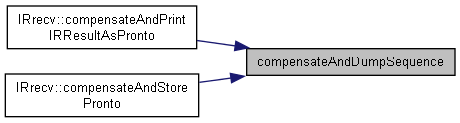
◆ compensateAndDumpSequence() [1/2]
|
static |
Definition at line 234 of file ir_Pronto.hpp.

◆ compensateAndDumpSequence() [2/2]
|
static |

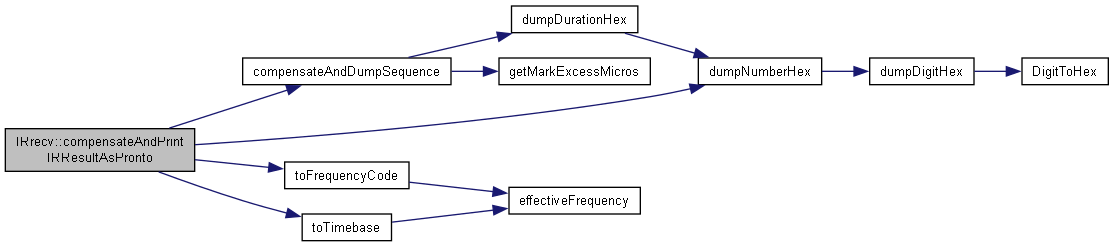
◆ compensateAndPrintIRResultAsPronto()
| void IRrecv::compensateAndPrintIRResultAsPronto | ( | Print * | aSerial, |
| uint16_t | aFrequencyHertz = 38000U |
||
| ) |
Print the result (second argument) as Pronto Hex on the Print supplied as argument.
Used in the ReceiveDump example. Do not print repeat sequence data.
- Parameters
-
aSerial The Print object on which to write, you can use &Serial for Arduino. aFrequencyHertz Modulation frequency in Hz. Often 38000Hz.
Definition at line 257 of file ir_Pronto.hpp.
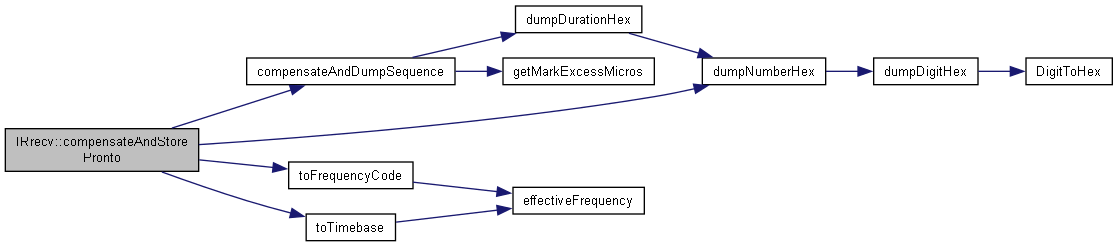
◆ compensateAndStorePronto()
| size_t IRrecv::compensateAndStorePronto | ( | String * | aString, |
| uint16_t | frequency = 38000U |
||
| ) |
◆ computeLGRawDataAndChecksum()
| uint32_t IRsend::computeLGRawDataAndChecksum | ( | uint8_t | aAddress, |
| uint16_t | aCommand | ||
| ) |

◆ computeNECRawDataAndChecksum()
| uint32_t IRsend::computeNECRawDataAndChecksum | ( | uint16_t | aAddress, |
| uint16_t | aCommand | ||
| ) |
Convert 16 bit address and 16 bit command to 32 bit NECRaw data If we get a command < 0x100, we send command and then ~command If we get an address < 0x100, we send 8 bit address and then ~address !!! Be aware, that this is flexible, but makes it impossible to send e.g.
0x0042 as 16 bit value!!! To force send 16 bit address, use: sendOnkyo().
Definition at line 157 of file ir_NEC.hpp.

◆ computeOpenLASIRRawCommand()
| uint16_t IRsend::computeOpenLASIRRawCommand | ( | uint8_t | aDeviceID, |
| uint8_t | aMode, | ||
| uint8_t | aData | ||
| ) |
Compute the raw 32-bit data for an OpenLASIR frame from 8-bit address, 8-bit DeviceID, 5-bit Mode and 3-bit Data.
- Parameters
-
aAddress 8-bit address (Block ID). Only lower 8 bits are used. aDeviceID 8-bit Device ID. aMode 5-bit Mode. aData 3-bit Data (color, etc.).
- Returns
- 32-bit raw data ready for transmission.
Definition at line 170 of file ir_OpenLASIR.hpp.

◆ computeOpenLASIRRawDataAndChecksum()
| uint32_t IRsend::computeOpenLASIRRawDataAndChecksum | ( | uint8_t | aAddress, |
| uint16_t | aCommand | ||
| ) |
Compute the raw 32-bit data for an OpenLASIR frame from 8-bit address and 16-bit command.
Address is sent as: [address:8][~address:8] (inverted complement for error checking) Command is sent as: [command:16] (no error check)
- Parameters
-
aAddress 8-bit address (Block ID). Only lower 8 bits are used. aCommand 16-bit command (contains Device ID, Mode, and Data).
- Returns
- 32-bit raw data ready for transmission.
Definition at line 148 of file ir_OpenLASIR.hpp.

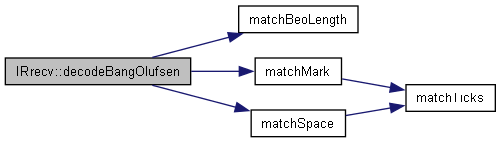
◆ decodeBangOlufsen()
| bool IRrecv::decodeBangOlufsen | ( | ) |
Definition at line 284 of file ir_BangOlufsen.hpp.

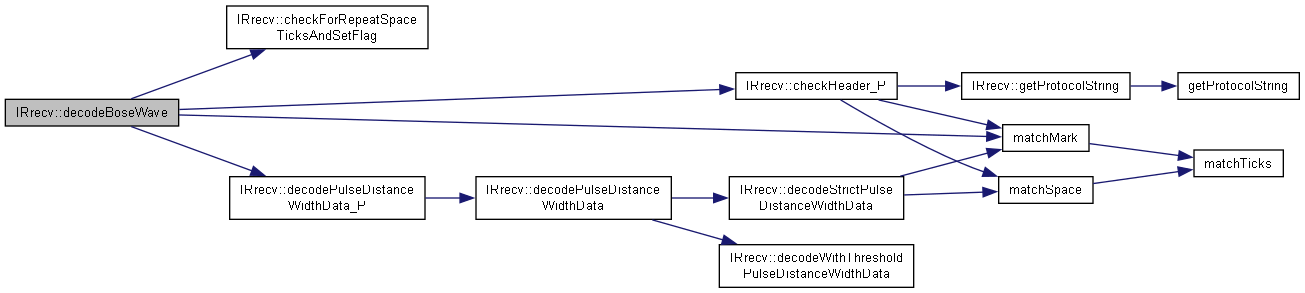
◆ decodeBoseWave()
| bool IRrecv::decodeBoseWave | ( | ) |
Definition at line 62 of file ir_BoseWave.hpp.

◆ decodeDenon()
| bool IRrecv::decodeDenon | ( | ) |
Definition at line 167 of file ir_Denon.hpp.


◆ decodeDenonOld()
| bool IRrecv::decodeDenonOld | ( | decode_results * | aResults | ) |
Definition at line 285 of file ir_Denon.hpp.


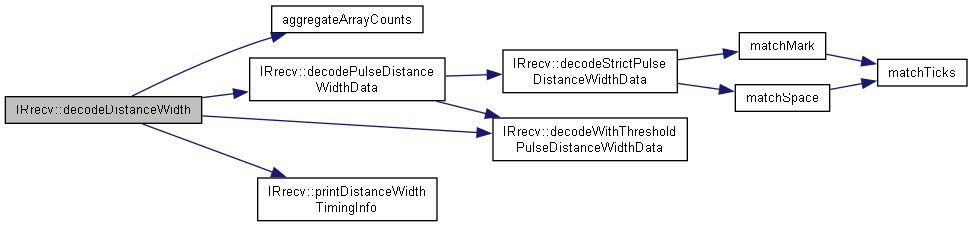
◆ decodeDistanceWidth()
| bool IRrecv::decodeDistanceWidth | ( | ) |
Definition at line 206 of file ir_DistanceWidthProtocol.hpp.

◆ decodeFAST()
| bool IRrecv::decodeFAST | ( | ) |
Definition at line 96 of file ir_FAST.hpp.


◆ decodeJVC()
| bool IRrecv::decodeJVC | ( | ) |
Definition at line 116 of file ir_JVC.hpp.


◆ decodeJVCMSB()
| bool IRrecv::decodeJVCMSB | ( | decode_results * | aResults | ) |
Definition at line 166 of file ir_JVC.hpp.


◆ decodeKaseikyo()
| bool IRrecv::decodeKaseikyo | ( | ) |
Definition at line 197 of file ir_Kaseikyo.hpp.


◆ decodeLegoPowerFunctions()
| bool IRrecv::decodeLegoPowerFunctions | ( | ) |
Definition at line 144 of file ir_Lego.hpp.


◆ decodeLG()
| bool IRrecv::decodeLG | ( | ) |


◆ decodeLGMSB()
| bool IRrecv::decodeLGMSB | ( | decode_results * | aResults | ) |


◆ decodeMagiQuest()
| bool IRrecv::decodeMagiQuest | ( | ) |
Definition at line 156 of file ir_MagiQuest.hpp.


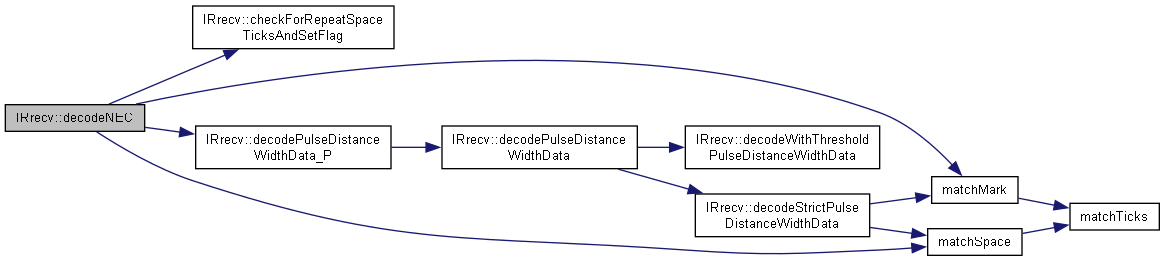
◆ decodeNEC()
| bool IRrecv::decodeNEC | ( | ) |
Decodes also Onkyo and Apple.
Definition at line 235 of file ir_NEC.hpp.

◆ decodeNECMSB()
| bool IRrecv::decodeNECMSB | ( | decode_results * | aResults | ) |
Definition at line 332 of file ir_NEC.hpp.


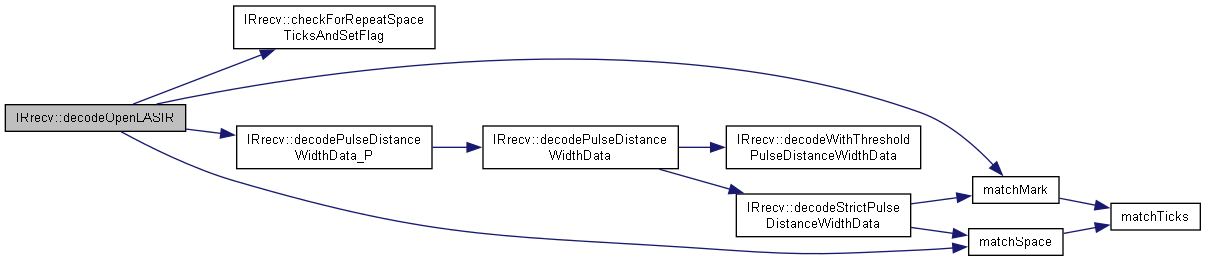
◆ decodeOpenLASIR()
| bool IRrecv::decodeOpenLASIR | ( | ) |
Decode an OpenLASIR frame.
OpenLASIR uses the same physical layer as NEC but with different address/command structure:
- 8-bit address with inverted complement (error check on address)
- 16-bit command without error check
The decoder validates the address by checking that the second byte is the bitwise inverse of the first byte. The full 16-bit command is returned as-is.
- Returns
- true if a valid OpenLASIR frame was decoded.
Definition at line 229 of file ir_OpenLASIR.hpp.

◆ decodeSamsung()
| bool IRrecv::decodeSamsung | ( | ) |
Definition at line 270 of file ir_Samsung.hpp.


◆ decodeSAMSUNG()
| bool IRrecv::decodeSAMSUNG | ( | decode_results * | aResults | ) |
Definition at line 361 of file ir_Samsung.hpp.


◆ decodeSharp()
| bool IRrecv::decodeSharp | ( | ) |

◆ decodeSony()
| bool IRrecv::decodeSony | ( | ) |
Definition at line 107 of file ir_Sony.hpp.


◆ decodeSonyMSB()
| bool IRrecv::decodeSonyMSB | ( | decode_results * | aResults | ) |

◆ decodeWhynter()
| bool IRrecv::decodeWhynter | ( | ) |
Definition at line 94 of file ir_Others.hpp.


◆ DigitToHex()
|
static |

◆ dumpDigitHex() [1/2]
|
static |
Definition at line 214 of file ir_Pronto.hpp.


◆ dumpDigitHex() [2/2]
|
static |

◆ dumpDurationHex() [1/2]
|
static |
Definition at line 227 of file ir_Pronto.hpp.


◆ dumpDurationHex() [2/2]
|
static |

◆ dumpNumberHex() [1/2]
|
static |
Definition at line 218 of file ir_Pronto.hpp.


◆ dumpNumberHex() [2/2]
|
static |

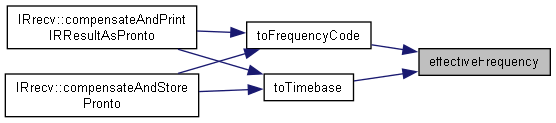
◆ effectiveFrequency()
|
static |
◆ matchBeoLength()
|
static |

◆ sendApple()
| void IRsend::sendApple | ( | uint8_t | aDeviceId, |
| uint8_t | aCommand, | ||
| int_fast8_t | aNumberOfRepeats | ||
| ) |
Apple: Send NEC with fixed 16 bit Apple address 0x87EE.
There is NO delay after the last sent repeat! https://en.wikipedia.org/wiki/Apple_Remote https://gist.github.com/darconeous/4437f79a34e3b6441628
- Parameters
-
aNumberOfRepeats If < 0 then only a special repeat frame without leading and trailing space will be sent by calling NECProtocolConstants.SpecialSendRepeatFunction().
Definition at line 210 of file ir_NEC.hpp.


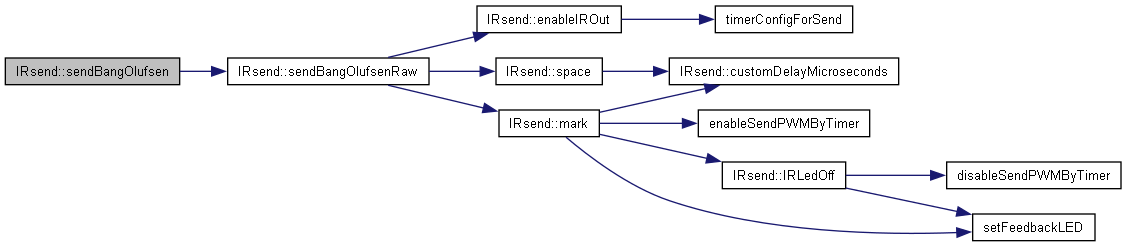
◆ sendBangOlufsen()
| void IRsend::sendBangOlufsen | ( | uint16_t | aHeader, |
| uint8_t | aData, | ||
| int_fast8_t | aNumberOfRepeats = NO_REPEATS, |
||
| int8_t | aNumberOfHeaderBits = 8 |
||
| ) |
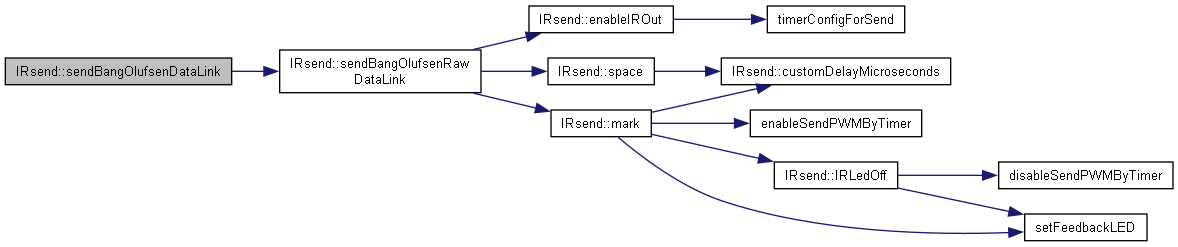
◆ sendBangOlufsenDataLink()
| void IRsend::sendBangOlufsenDataLink | ( | uint32_t | aHeader, |
| uint8_t | aData, | ||
| int_fast8_t | aNumberOfRepeats = NO_REPEATS, |
||
| int8_t | aNumberOfHeaderBits = 8 |
||
| ) |
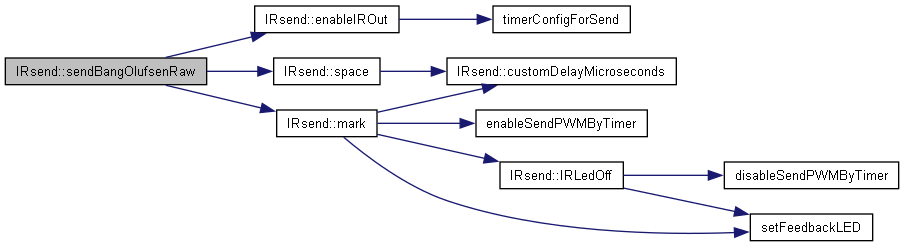
◆ sendBangOlufsenRaw()
| void IRsend::sendBangOlufsenRaw | ( | uint32_t | aRawData, |
| int_fast8_t | aBits, | ||
| bool | aBackToBack = false |
||
| ) |
Definition at line 157 of file ir_BangOlufsen.hpp.

◆ sendBangOlufsenRawDataLink()
| void IRsend::sendBangOlufsenRawDataLink | ( | uint64_t | aRawData, |
| int_fast8_t | aBits, | ||
| bool | aBackToBack = false, |
||
| bool | aUseDatalinkTiming = false |
||
| ) |
Definition at line 221 of file ir_BangOlufsen.hpp.
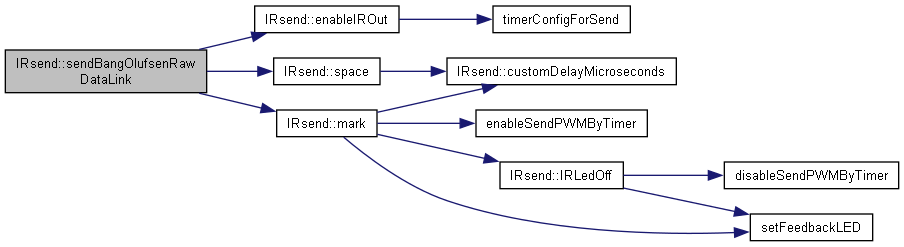

◆ sendBoseWave()
| void IRsend::sendBoseWave | ( | uint8_t | aCommand, |
| int_fast8_t | aNumberOfRepeats = NO_REPEATS |
||
| ) |
Definition at line 55 of file ir_BoseWave.hpp.


◆ sendDenon() [1/2]
| void IRsend::sendDenon | ( | uint8_t | aAddress, |
| uint8_t | aCommand, | ||
| int_fast8_t | aNumberOfRepeats, | ||
| uint8_t | aSendSharpFrameMarker = 0 |
||
| ) |
Definition at line 129 of file ir_Denon.hpp.

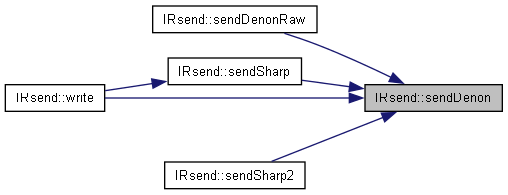
◆ sendDenon() [2/2]
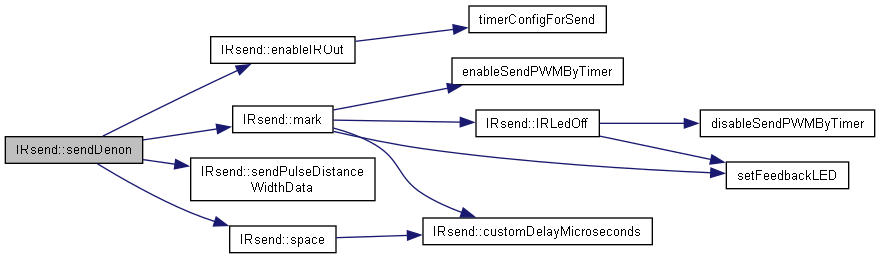
| void IRsend::sendDenon | ( | unsigned long | data, |
| int | nbits | ||
| ) |
◆ sendDenonRaw()
| void IRsend::sendDenonRaw | ( | uint16_t | aRawData, |
| int_fast8_t | aNumberOfRepeats = NO_REPEATS |
||
| ) |

◆ sendDish()
| void IRsend::sendDish | ( | uint16_t | aData | ) |

◆ sendFAST()
| void IRsend::sendFAST | ( | uint8_t | aCommand, |
| int_fast8_t | aNumberOfRepeats | ||
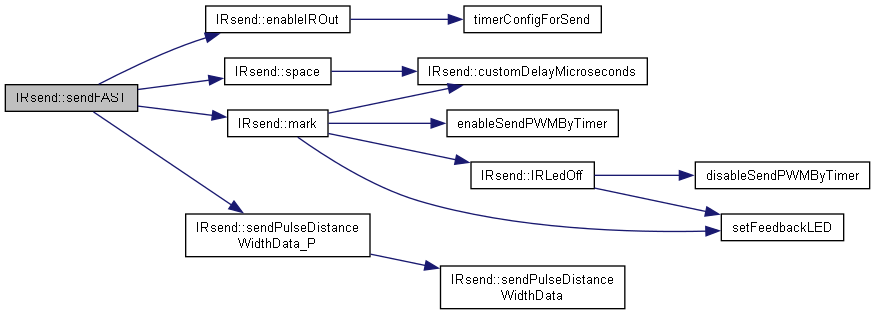
| ) |
The FAST protocol repeats by skipping the header mark and space -> this leads to a poor repeat detection for JVC protocol.
Definition at line 75 of file ir_FAST.hpp.

◆ sendJVC()
| void IRsend::sendJVC | ( | uint8_t | aAddress, |
| uint8_t | aCommand, | ||
| int_fast8_t | aNumberOfRepeats | ||
| ) |
The JVC protocol repeats by skipping the header mark and space -> this leads to a poor repeat detection for JVC protocol.
Definition at line 89 of file ir_JVC.hpp.
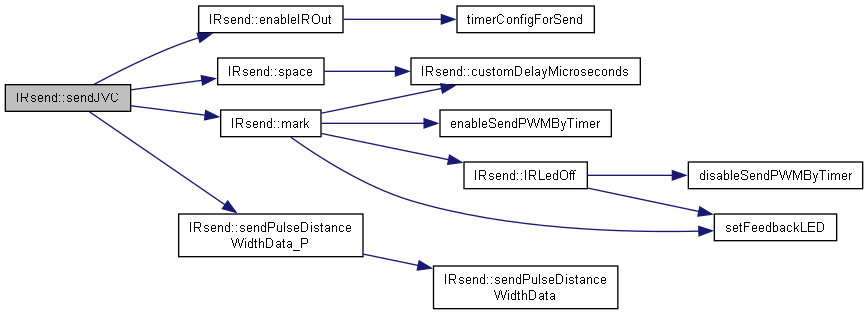

◆ sendJVCMSB()
| void IRsend::sendJVCMSB | ( | unsigned long | data, |
| int | nbits, | ||
| bool | repeat = false |
||
| ) |
With Send sendJVCMSB() you can send your old 32 bit codes.
To convert one into the other, you must reverse the byte positions and then reverse all bit positions of each byte. Use bitreverse32Bit(). Or write it as one binary string and reverse/mirror it. Example: 0xCB340102 byte reverse -> 02 01 34 CB bit reverse-> 40 80 2C D3. 0xCB340102 is binary 11001011001101000000000100000010. 0x40802CD3 is binary 01000000100000000010110011010011. If you read the first binary sequence backwards (right to left), you get the second sequence.
Definition at line 227 of file ir_JVC.hpp.
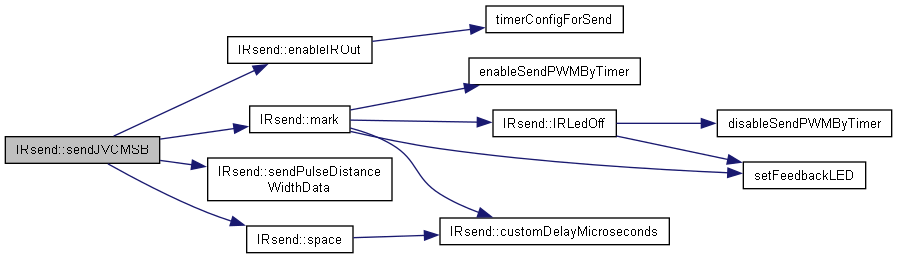

◆ sendKaseikyo()
| void IRsend::sendKaseikyo | ( | uint16_t | aAddress, |
| uint8_t | aData, | ||
| int_fast8_t | aNumberOfRepeats, | ||
| uint16_t | aVendorCode | ||
| ) |
Address can be interpreted as sub-device << 4 + 4 bit device.
Definition at line 130 of file ir_Kaseikyo.hpp.

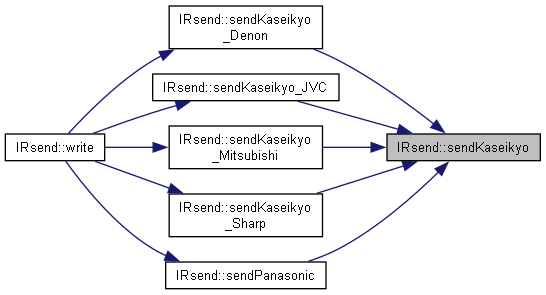
◆ sendKaseikyo_Denon()
| void IRsend::sendKaseikyo_Denon | ( | uint16_t | aAddress, |
| uint8_t | aData, | ||
| int_fast8_t | aNumberOfRepeats | ||
| ) |
Stub using Kaseikyo with DENON_VENDOR_ID_CODE.
Definition at line 169 of file ir_Kaseikyo.hpp.


◆ sendKaseikyo_JVC()
| void IRsend::sendKaseikyo_JVC | ( | uint16_t | aAddress, |
| uint8_t | aData, | ||
| int_fast8_t | aNumberOfRepeats | ||
| ) |
Stub using Kaseikyo with JVC_VENDOR_ID_CODE.
Definition at line 190 of file ir_Kaseikyo.hpp.


◆ sendKaseikyo_Mitsubishi()
| void IRsend::sendKaseikyo_Mitsubishi | ( | uint16_t | aAddress, |
| uint8_t | aData, | ||
| int_fast8_t | aNumberOfRepeats | ||
| ) |
Stub using Kaseikyo with MITSUBISHI_VENDOR_ID_CODE.
Definition at line 176 of file ir_Kaseikyo.hpp.


◆ sendKaseikyo_Sharp()
| void IRsend::sendKaseikyo_Sharp | ( | uint16_t | aAddress, |
| uint8_t | aData, | ||
| int_fast8_t | aNumberOfRepeats | ||
| ) |
Stub using Kaseikyo with SHARP_VENDOR_ID_CODE.
Definition at line 183 of file ir_Kaseikyo.hpp.


◆ sendLegoPowerFunctions() [1/3]
| void IRsend::sendLegoPowerFunctions | ( | uint16_t | aRawData, |
| bool | aDoSend5Times = true |
||
| ) |

◆ sendLegoPowerFunctions() [2/3]
| void IRsend::sendLegoPowerFunctions | ( | uint16_t | aRawData, |
| uint8_t | aChannel, | ||
| bool | aDoSend5Times = true |
||
| ) |
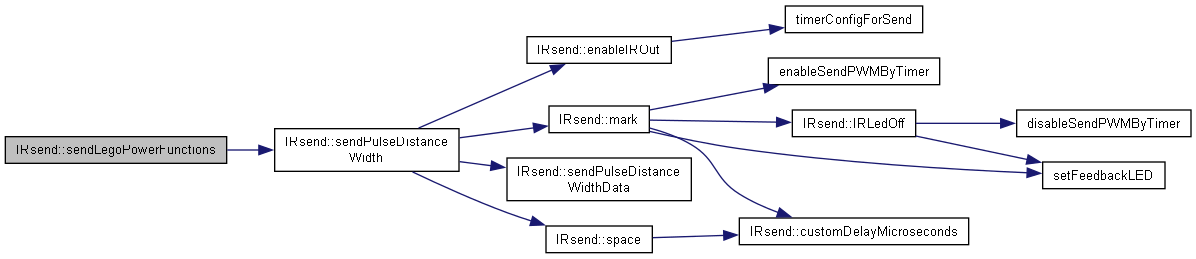
◆ sendLegoPowerFunctions() [3/3]
| void IRsend::sendLegoPowerFunctions | ( | uint8_t | aChannel, |
| uint8_t | tCommand, | ||
| uint8_t | aMode, | ||
| bool | aDoSend5Times = true |
||
| ) |

◆ sendLG() [1/2]
| void IRsend::sendLG | ( | uint8_t | aAddress, |
| uint16_t | aCommand, | ||
| int_fast8_t | aNumberOfRepeats | ||
| ) |


◆ sendLG() [2/2]
| void IRsend::sendLG | ( | unsigned long | data, |
| int | nbits | ||
| ) |
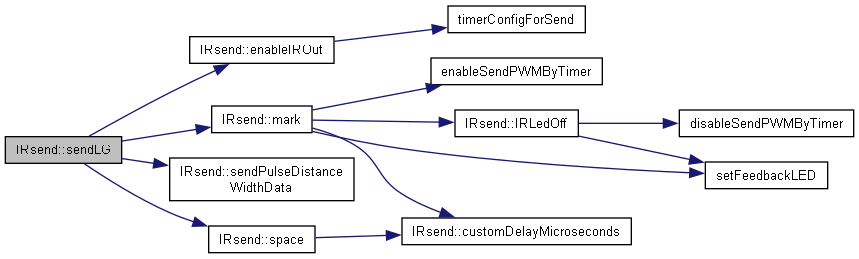
◆ sendLG2()
| void IRsend::sendLG2 | ( | uint8_t | aAddress, |
| uint16_t | aCommand, | ||
| int_fast8_t | aNumberOfRepeats | ||
| ) |


◆ sendLG2Repeat()
| void IRsend::sendLG2Repeat | ( | ) |
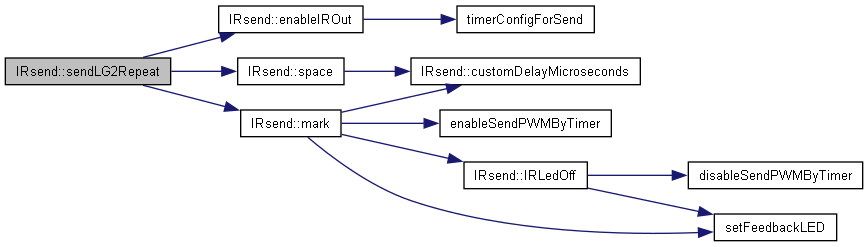
◆ sendLG2SpecialRepeat()
| void sendLG2SpecialRepeat | ( | ) |
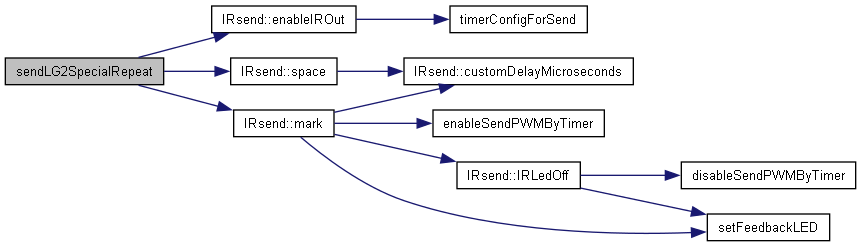
◆ sendLGRaw()
| void IRsend::sendLGRaw | ( | uint32_t | aRawData, |
| int_fast8_t | aNumberOfRepeats = NO_REPEATS |
||
| ) |

◆ sendMagiQuest()
| void IRsend::sendMagiQuest | ( | uint32_t | aWandId, |
| uint16_t | aMagnitude | ||
| ) |
- Parameters
-
aWandId 31 bit ID aMagnitude 9 bit Magnitude
Definition at line 124 of file ir_MagiQuest.hpp.


◆ sendNEC()
| void IRsend::sendNEC | ( | uint16_t | aAddress, |
| uint16_t | aCommand, | ||
| int_fast8_t | aNumberOfRepeats | ||
| ) |
NEC Send frame and special repeats There is NO delay after the last sent repeat!
- Parameters
-
aNumberOfRepeats If < 0 then only a special NEC repeat frame will be sent by calling NECProtocolConstants.SpecialSendRepeatFunction().
Definition at line 180 of file ir_NEC.hpp.


◆ sendNEC2()
| void IRsend::sendNEC2 | ( | uint16_t | aAddress, |
| uint16_t | aCommand, | ||
| int_fast8_t | aNumberOfRepeats | ||
| ) |
NEC2 Send frame !!! and repeat the frame for each requested repeat !!! There is NO delay after the last sent repeat!
- Parameters
-
aNumberOfRepeats If < 0 then nothing is sent.
Definition at line 198 of file ir_NEC.hpp.


◆ sendNECMSB()
| void IRsend::sendNECMSB | ( | uint32_t | data, |
| uint8_t | nbits, | ||
| bool | repeat = false |
||
| ) |
With Send sendNECMSB() you can send your old 32 bit codes.
To convert one into the other, you must reverse the byte positions and then reverse all bit positions of each byte. Use bitreverse32Bit(). Or write it as one binary string and reverse/mirror it. Example: 0xCB340102 byte reverse -> 02 01 34 CB bit reverse-> 40 80 2C D3. 0xCB340102 is binary 11001011001101000000000100000010. 0x40802CD3 is binary 01000000100000000010110011010011. If you read the first binary sequence backwards (right to left), you get the second sequence.
Definition at line 394 of file ir_NEC.hpp.
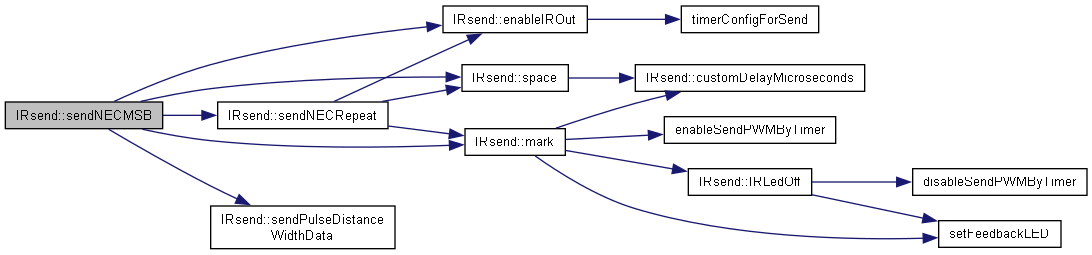

◆ sendNECRaw()
| void IRsend::sendNECRaw | ( | uint32_t | aRawData, |
| int_fast8_t | aNumberOfRepeats = NO_REPEATS |
||
| ) |
Sends NEC protocol.
- Parameters
-
aNumberOfRepeats If < 0 then only a special repeat frame without leading and trailing space will be sent by calling NECProtocolConstants.SpecialSendRepeatFunction().
Definition at line 228 of file ir_NEC.hpp.

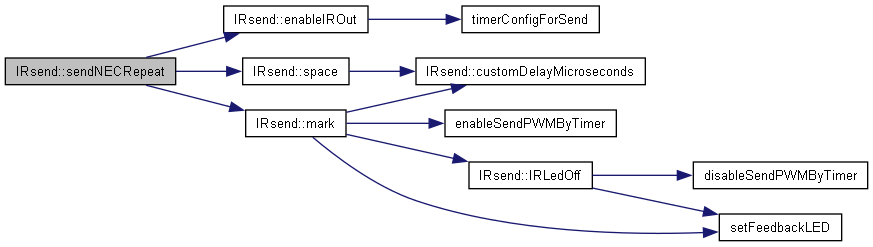
◆ sendNECRepeat()
| void IRsend::sendNECRepeat | ( | ) |
Send special NEC repeat frame Repeat commands should be sent in a 110 ms raster.
Definition at line 132 of file ir_NEC.hpp.

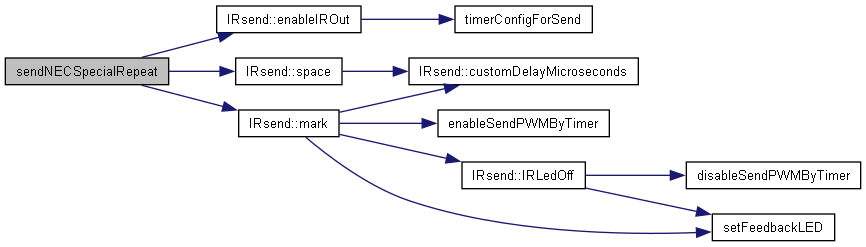
◆ sendNECSpecialRepeat()
| void sendNECSpecialRepeat | ( | ) |
Static function variant of IRsend::sendNECRepeat For use in ProtocolConstants.
Saves up to 250 bytes compared to a member function.
Definition at line 143 of file ir_NEC.hpp.

◆ sendOnkyo()
| void IRsend::sendOnkyo | ( | uint16_t | aAddress, |
| uint16_t | aCommand, | ||
| int_fast8_t | aNumberOfRepeats | ||
| ) |
There is NO delay after the last sent repeat!
- Parameters
-
aNumberOfRepeats If < 0 then only a special repeat frame without leading and trailing space will be sent by calling NECProtocolConstants.SpecialSendRepeatFunction().
Definition at line 189 of file ir_NEC.hpp.


◆ sendOpenLASIR() [1/2]
| void IRsend::sendOpenLASIR | ( | uint8_t | aAddress, |
| uint16_t | aCommand, | ||
| int_fast8_t | aNumberOfRepeats | ||
| ) |
Send an OpenLASIR frame with special NEC-style repeats.
There is NO delay after the last sent repeat!
- Parameters
-
aAddress 8-bit address (Block ID). Only lower 8 bits are used. aCommand 16-bit command (Device ID + Mode + Data). aNumberOfRepeats If < 0 then only a special repeat frame will be sent.
Definition at line 187 of file ir_OpenLASIR.hpp.


◆ sendOpenLASIR() [2/2]
| void IRsend::sendOpenLASIR | ( | uint8_t | aAddress, |
| uint8_t | aDeviceID, | ||
| uint8_t | aMode, | ||
| uint8_t | aData, | ||
| int_fast8_t | aNumberOfRepeats | ||
| ) |
Send an OpenLASIR frame with special NEC-style repeats.
There is NO delay after the last sent repeat!
- Parameters
-
aAddress 8-bit address (Block ID). Only lower 8 bits are used. aDeviceID 8-bit Device ID. aMode 5-bit Mode. aData 3-bit Data (color, etc.). aNumberOfRepeats If < 0 then only a special repeat frame will be sent.
Definition at line 202 of file ir_OpenLASIR.hpp.

◆ sendOpenLASIRRaw()
| void IRsend::sendOpenLASIRRaw | ( | uint32_t | aRawData, |
| int_fast8_t | aNumberOfRepeats = NO_REPEATS |
||
| ) |
Send raw 32-bit OpenLASIR data.
- Parameters
-
aRawData The pre-computed 32-bit raw data. aNumberOfRepeats If < 0 then only a special repeat frame will be sent.
Definition at line 213 of file ir_OpenLASIR.hpp.

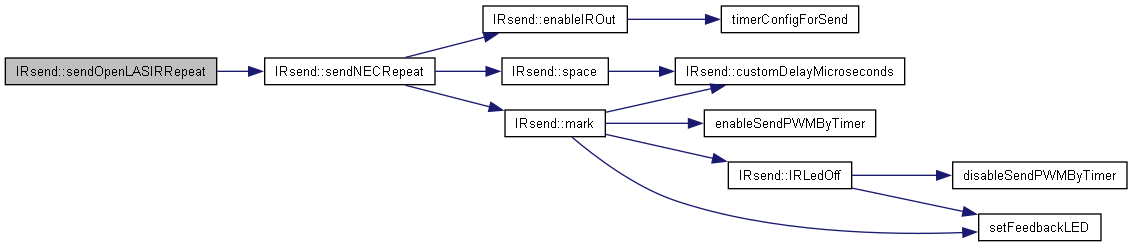
◆ sendOpenLASIRRepeat()
| void IRsend::sendOpenLASIRRepeat | ( | ) |
Send special OpenLASIR repeat frame (same as NEC repeat frame).
Repeat commands should be sent in a 110 ms raster.
Definition at line 127 of file ir_OpenLASIR.hpp.
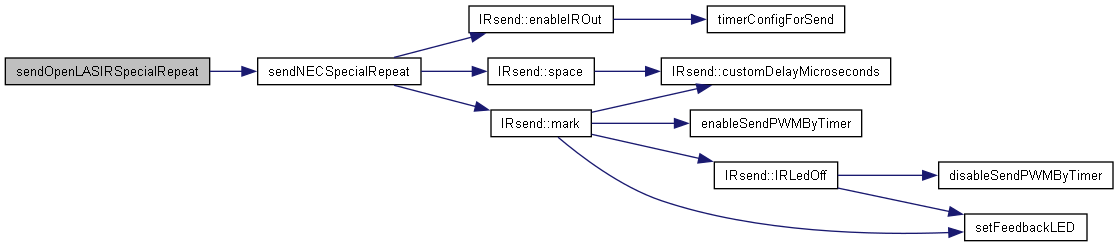
◆ sendOpenLASIRSpecialRepeat()
| void sendOpenLASIRSpecialRepeat | ( | ) |
Static function variant of IRsend::sendOpenLASIRRepeat For use in ProtocolConstants.
Saves up to 250 bytes compared to a member function.
Definition at line 135 of file ir_OpenLASIR.hpp.
◆ sendPanasonic()
| void IRsend::sendPanasonic | ( | uint16_t | aAddress, |
| uint8_t | aData, | ||
| int_fast8_t | aNumberOfRepeats | ||
| ) |
Stub using Kaseikyo with PANASONIC_VENDOR_ID_CODE.
Definition at line 162 of file ir_Kaseikyo.hpp.


◆ sendPronto() [1/3]
| void IRsend::sendPronto | ( | const __FlashStringHelper * | str, |
| int_fast8_t | aNumberOfRepeats = NO_REPEATS |
||
| ) |

◆ sendPronto() [2/3]
| void IRsend::sendPronto | ( | const char * | str, |
| int_fast8_t | aNumberOfRepeats = NO_REPEATS |
||
| ) |
Parse the string given as Pronto Hex, and send it a number of times given as the second argument.
Thereby the division of the Pronto Hex into an intro-sequence and a repeat sequence is taken into account: First the intro sequence is sent, then the repeat sequence is sent times-1 times. However, if the intro sequence is empty, the repeat sequence is sent times times. Reference.
Note: Using this function is very wasteful for the memory consumption on a small board. Normally it is a much better idea to use a tool like e.g. IrScrutinizer to transform Pronto type signals offline to a more memory efficient format.
- Parameters
-
str C type string (null terminated) containing a Pronto Hex representation. aNumberOfRepeats Number of times to send the signal.
Definition at line 147 of file ir_Pronto.hpp.

◆ sendPronto() [3/3]
| void IRsend::sendPronto | ( | const uint16_t * | data, |
| uint16_t | length, | ||
| int_fast8_t | aNumberOfRepeats = NO_REPEATS |
||
| ) |
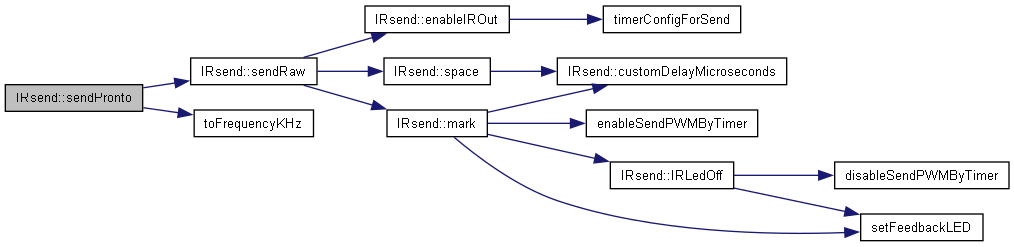
◆ sendRC5() [1/2]
| void IRsend::sendRC5 | ( | uint32_t | data, |
| uint8_t | nbits | ||
| ) |
Old version with 32 bit data.
Definition at line 810 of file ir_RC5_RC6.hpp.
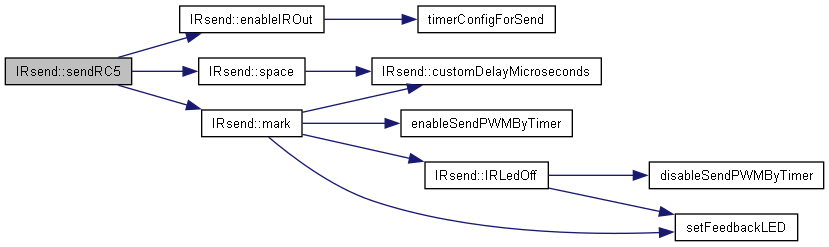
◆ sendRC5() [2/2]
| void IRsend::sendRC5 | ( | uint8_t | aAddress, |
| uint8_t | aCommand, | ||
| int_fast8_t | aNumberOfRepeats, | ||
| bool | aEnableAutomaticToggle = true |
||
| ) |
- Parameters
-
aAddress 5 address bits to be sent first (MSB first). aCommand 6 or 7 (RC5X) bits. If aCommand is >=0x40 then we switch automatically to RC5X. aEnableAutomaticToggle Send toggle bit according to the state of the static sLastSendToggleValue variable.
Definition at line 189 of file ir_RC5_RC6.hpp.
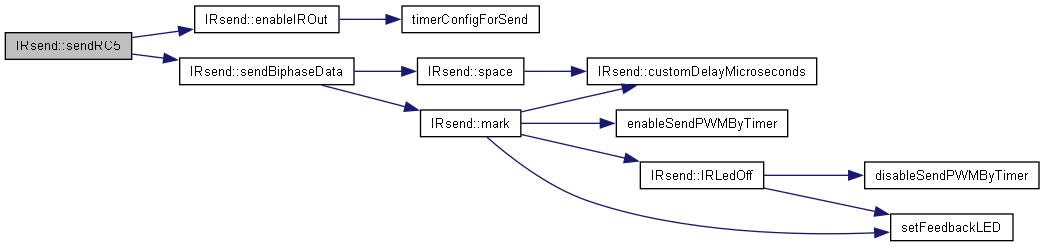

◆ sendRC5ext()
| void IRsend::sendRC5ext | ( | uint8_t | addr, |
| uint8_t | cmd, | ||
| bool | toggle | ||
| ) |
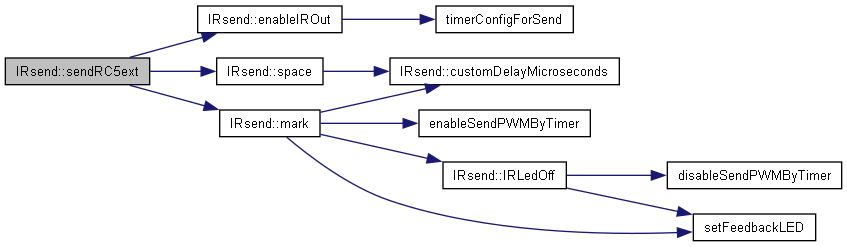
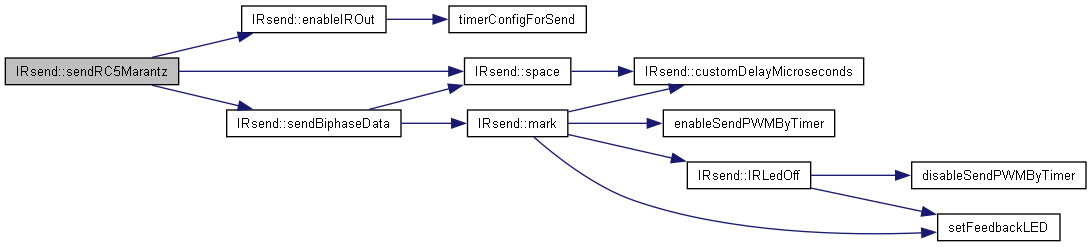
◆ sendRC5Marantz()
| void IRsend::sendRC5Marantz | ( | uint8_t | aAddress, |
| uint8_t | aCommand, | ||
| int_fast8_t | aNumberOfRepeats, | ||
| uint8_t | aMarantzExtension, | ||
| bool | aEnableAutomaticToggle = true |
||
| ) |
!!! Not tested, because no Marantz remote was at hand and no receive function was contributed!!! Send function for the Marantz version of RC5(X) with a pause of 4 * RC5_UNIT after address / first 8 bits and before the bits of command and command extension.
Marantz seems to require at least one repetition with toggle bit set
- Parameters
-
aAddress 5 address bits to be sent first (MSB first). aCommand 6 or 7 (RC5X) bits. If aCommand is >=0x40 then we switch automatically to RC5X. aMarantzExtension 6 bit command extension which is sent after 6 command bits of aCommand. aCommand and aMarantzExtension are sent after a short pause. aEnableAutomaticToggle Send toggle bit according to the state of the static sLastSendToggleValue variable.
Definition at line 130 of file ir_RC5_RC6.hpp.
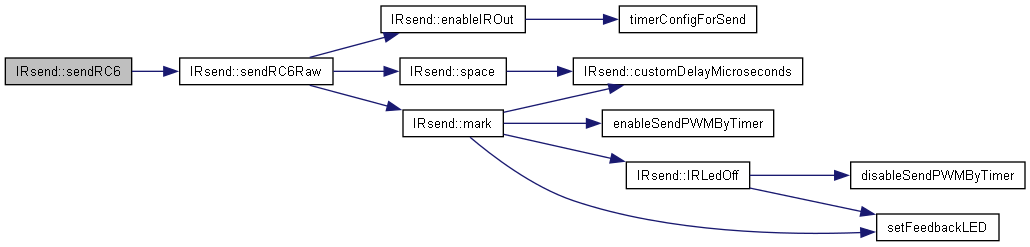
◆ sendRC6() [1/3]
| void IRsend::sendRC6 | ( | uint32_t | data, |
| uint8_t | nbits | ||
| ) |
Main RC6 send function.
Definition at line 522 of file ir_RC5_RC6.hpp.
◆ sendRC6() [2/3]
| void IRsend::sendRC6 | ( | uint64_t | data, |
| uint8_t | nbits | ||
| ) |
Send RC6 64 bit raw data Can be used to send RC6A with ?31? data bits.
Definition at line 556 of file ir_RC5_RC6.hpp.
◆ sendRC6() [3/3]
| void IRsend::sendRC6 | ( | uint8_t | aAddress, |
| uint8_t | aCommand, | ||
| int_fast8_t | aNumberOfRepeats, | ||
| bool | aEnableAutomaticToggle = true |
||
| ) |
Assemble raw data for RC6 from parameters and toggle state and send We do not wait for the minimal trailing space of 2666 us.
- Parameters
-
aEnableAutomaticToggle Send toggle bit according to the state of the static sLastSendToggleValue variable.
Definition at line 591 of file ir_RC5_RC6.hpp.

◆ sendRC6A()
| void IRsend::sendRC6A | ( | uint8_t | aAddress, |
| uint8_t | aCommand, | ||
| int_fast8_t | aNumberOfRepeats, | ||
| uint16_t | aCustomer, | ||
| bool | aEnableAutomaticToggle = true |
||
| ) |
Assemble raw data for RC6 from parameters and toggle state and send We do not wait for the minimal trailing space of 2666 us.
- Parameters
-
aEnableAutomaticToggle Send toggle bit according to the state of the static sLastSendToggleValue variable.
Definition at line 633 of file ir_RC5_RC6.hpp.
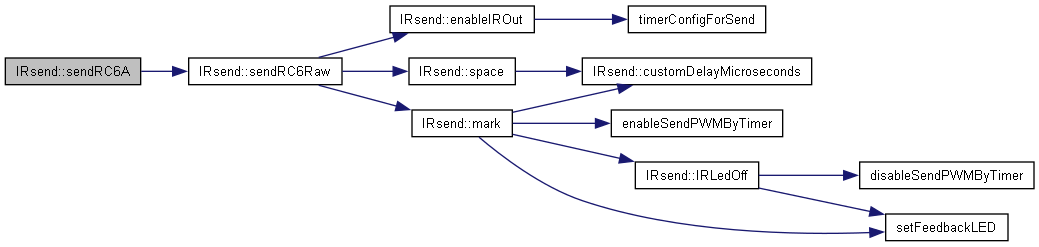
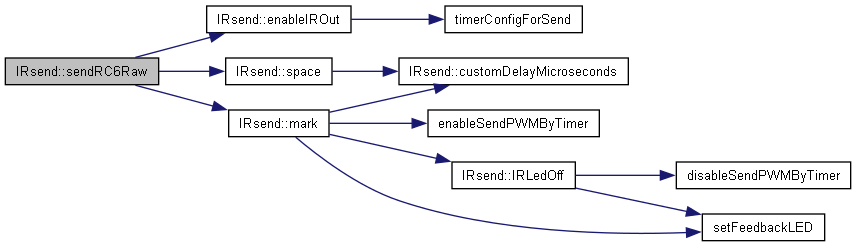
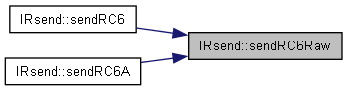
◆ sendRC6Raw() [1/2]
| void IRsend::sendRC6Raw | ( | uint32_t | data, |
| uint8_t | nbits | ||
| ) |
Definition at line 525 of file ir_RC5_RC6.hpp.
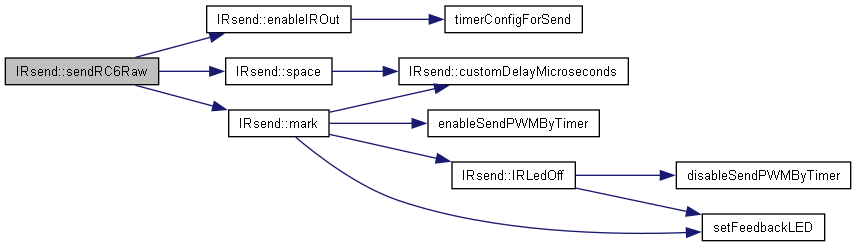
◆ sendRC6Raw() [2/2]
| void IRsend::sendRC6Raw | ( | uint64_t | data, |
| uint8_t | nbits | ||
| ) |
◆ sendSamsung()
| void IRsend::sendSamsung | ( | uint16_t | aAddress, |
| uint16_t | aCommand, | ||
| int_fast8_t | aNumberOfRepeats | ||
| ) |
Here we send Samsung32 If we get a command < 0x100, we send command and then ~command If we get an address < 0x100, we send 8 bit address and then the same 8 bit address again, this makes it flipper IRDB compatible !!! Be aware, that this is flexible, but makes it impossible to send e.g.
0x0042 as 16 bit value!!! To force send 16 bit address, use: sendSamsung16BitAddressAndCommand().
- Parameters
-
aNumberOfRepeats If < 0 then only a special repeat frame will be sent
Definition at line 172 of file ir_Samsung.hpp.


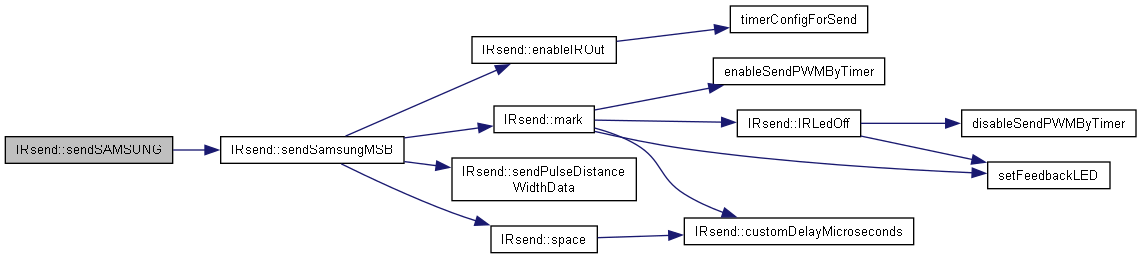
◆ sendSAMSUNG()
| void IRsend::sendSAMSUNG | ( | unsigned long | data, |
| int | nbits | ||
| ) |
◆ sendSamsung16BitAddressAnd8BitCommand()
| void IRsend::sendSamsung16BitAddressAnd8BitCommand | ( | uint16_t | aAddress, |
| uint8_t | aCommand, | ||
| int_fast8_t | aNumberOfRepeats | ||
| ) |
Maybe no one needs it in the wild...
As above, but we are able to send e.g. 0x0042 as 16 bit address
- Parameters
-
aNumberOfRepeats If < 0 then only a special repeat frame will be sent
Definition at line 203 of file ir_Samsung.hpp.

◆ sendSamsung16BitAddressAndCommand()
| void IRsend::sendSamsung16BitAddressAndCommand | ( | uint16_t | aAddress, |
| uint16_t | aCommand, | ||
| int_fast8_t | aNumberOfRepeats | ||
| ) |
Maybe no one needs it in the wild...
As above, but we are able to send e.g. 0x0042 as 16 bit address
- Parameters
-
aNumberOfRepeats If < 0 then only a special repeat frame will be sent
Definition at line 220 of file ir_Samsung.hpp.

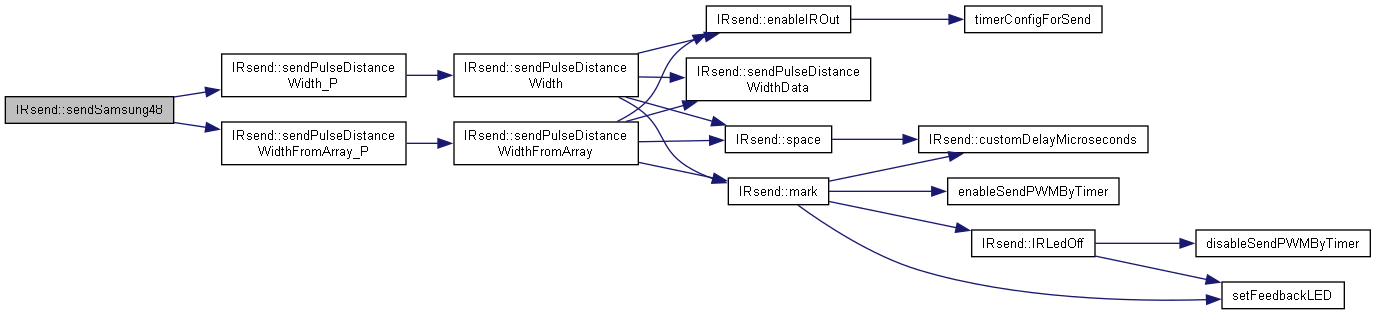
◆ sendSamsung48()
| void IRsend::sendSamsung48 | ( | uint16_t | aAddress, |
| uint32_t | aCommand, | ||
| int_fast8_t | aNumberOfRepeats | ||
| ) |
Here we send Samsung48 We send 2 x (8 bit command and then ~command)
Definition at line 234 of file ir_Samsung.hpp.

◆ sendSamsungLG()
| void IRsend::sendSamsungLG | ( | uint16_t | aAddress, |
| uint16_t | aCommand, | ||
| int_fast8_t | aNumberOfRepeats | ||
| ) |
Definition at line 146 of file ir_Samsung.hpp.


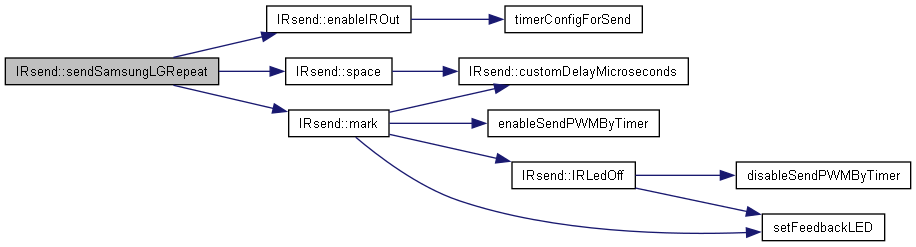
◆ sendSamsungLGRepeat()
| void IRsend::sendSamsungLGRepeat | ( | ) |
Send repeat Repeat commands should be sent in a 110 ms raster.
This repeat was sent by an LG 6711R1P071A remote
Definition at line 118 of file ir_Samsung.hpp.

◆ sendSamsungLGSpecialRepeat()
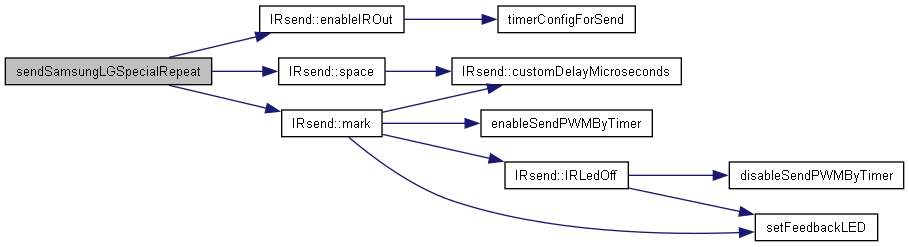
| void sendSamsungLGSpecialRepeat | ( | ) |
Like above, but implemented as a static function Used for sending special repeat frame.
For use in ProtocolConstants. Saves up to 250 bytes compared to a member function.
Definition at line 132 of file ir_Samsung.hpp.
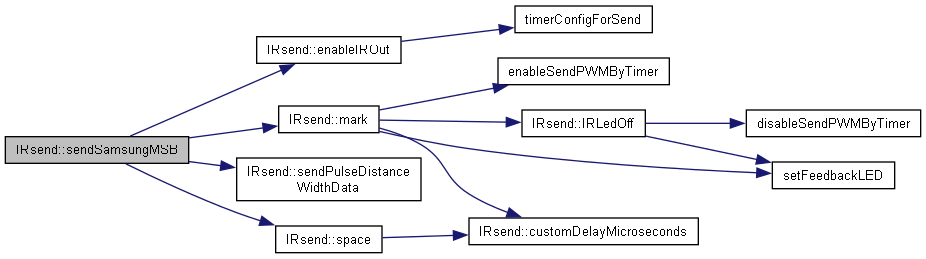
◆ sendSamsungMSB()
| void IRsend::sendSamsungMSB | ( | unsigned long | data, |
| int | nbits | ||
| ) |
Definition at line 399 of file ir_Samsung.hpp.

◆ sendSharp() [1/2]
| void IRsend::sendSharp | ( | uint16_t | address, |
| uint16_t | command | ||
| ) |

◆ sendSharp() [2/2]
| void IRsend::sendSharp | ( | uint8_t | aAddress, |
| uint8_t | aCommand, | ||
| int_fast8_t | aNumberOfRepeats | ||
| ) |
Definition at line 114 of file ir_Denon.hpp.


◆ sendSharp2()
| void IRsend::sendSharp2 | ( | uint8_t | aAddress, |
| uint8_t | aCommand, | ||
| int_fast8_t | aNumberOfRepeats | ||
| ) |

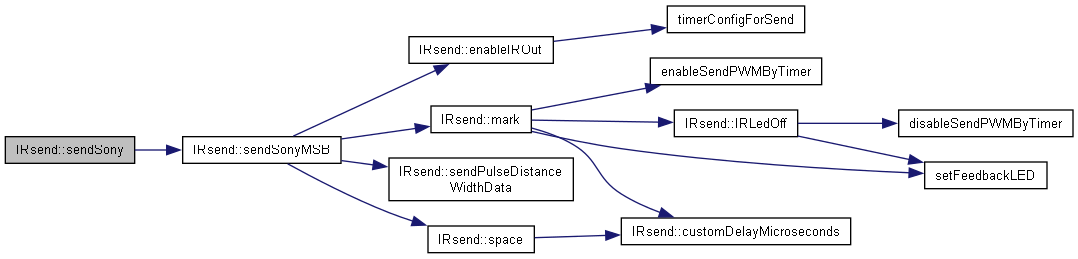
◆ sendSony() [1/2]
| void IRsend::sendSony | ( | uint16_t | aAddress, |
| uint8_t | aCommand, | ||
| int_fast8_t | aNumberOfRepeats, | ||
| uint8_t | numberOfBits = 12 |
||
| ) |
- Parameters
-
numberOfBits should be one of SIRCS_12_PROTOCOL, SIRCS_15_PROTOCOL, SIRCS_20_PROTOCOL. Not checked! 20 -> send 13 address bits
Definition at line 101 of file ir_Sony.hpp.


◆ sendSony() [2/2]
| void IRsend::sendSony | ( | unsigned long | data, |
| int | nbits | ||
| ) |
◆ sendSonyMSB()
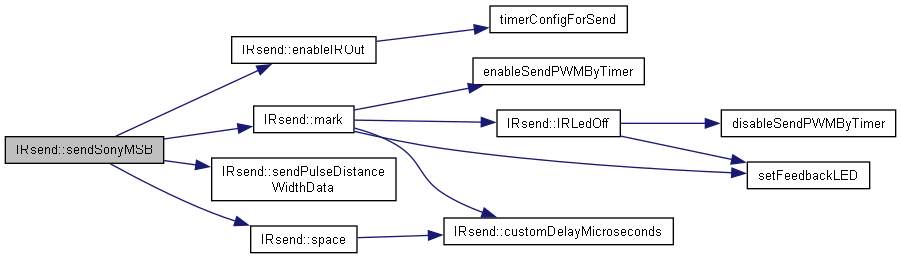
| void IRsend::sendSonyMSB | ( | unsigned long | data, |
| int | nbits | ||
| ) |
Old version with MSB first data.
Definition at line 206 of file ir_Sony.hpp.

◆ sendVelux() [1/2]
| void IRsend::sendVelux | ( | uint32_t | aData, |
| int_fast8_t | aNumberOfRepeats | ||
| ) |

◆ sendVelux() [2/2]
| void IRsend::sendVelux | ( | uint8_t | aCommand, |
| uint8_t | aMotorNumber, | ||
| uint8_t | aMotorSet, | ||
| uint16_t | aSecurityCode, | ||
| int_fast8_t | aNumberOfRepeats | ||
| ) |
Definition at line 181 of file ir_Others.hpp.
◆ sendWhynter()
| void IRsend::sendWhynter | ( | uint32_t | aData, |
| int_fast8_t | aNumberOfRepeats | ||
| ) |

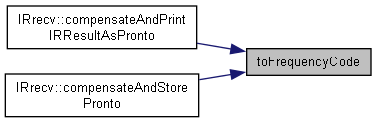
◆ toFrequencyCode()
|
static |
Definition at line 206 of file ir_Pronto.hpp.

◆ toFrequencyKHz()
|
static |

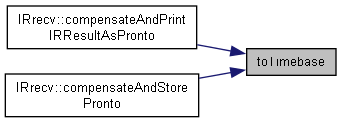
◆ toTimebase()
|
static |
Definition at line 202 of file ir_Pronto.hpp.

Variable Documentation
◆ LegoProtocolConstants
| struct PulseDistanceWidthProtocolConstants LegoProtocolConstants |
Definition at line 1 of file ir_Lego.hpp.
◆ PROGMEM [1/11]
| struct PulseDistanceWidthProtocolConstants const SonyProtocolConstants PROGMEM |
Definition at line 1 of file ir_Sony.hpp.
◆ PROGMEM [2/11]
| struct PulseDistanceWidthProtocolConstants const SamsungLGProtocolConstants PROGMEM |
Definition at line 1 of file ir_Samsung.hpp.
◆ PROGMEM [3/11]
| struct PulseDistanceWidthProtocolConstants const DenonProtocolConstants PROGMEM |
Definition at line 1 of file ir_Denon.hpp.
◆ PROGMEM [4/11]
| struct PulseDistanceWidthProtocolConstants const VeluxProtocolConstants PROGMEM |
Definition at line 1 of file ir_Others.hpp.
◆ PROGMEM [5/11]
| struct PulseDistanceWidthProtocolConstants const NEC2ProtocolConstants PROGMEM |
Definition at line 1 of file ir_NEC.hpp.
◆ PROGMEM [6/11]
| struct PulseDistanceWidthProtocolConstants const JVCProtocolConstants PROGMEM |
Definition at line 1 of file ir_JVC.hpp.
◆ PROGMEM [7/11]
| struct PulseDistanceWidthProtocolConstants const LG2ProtocolConstants PROGMEM |
◆ PROGMEM [8/11]
| struct PulseDistanceWidthProtocolConstants const FASTProtocolConstants PROGMEM |
Definition at line 1 of file ir_FAST.hpp.
◆ PROGMEM [9/11]
| struct PulseDistanceWidthProtocolConstants const KaseikyoProtocolConstants PROGMEM |
Definition at line 1 of file ir_Kaseikyo.hpp.
◆ PROGMEM [10/11]
| struct PulseDistanceWidthProtocolConstants const MagiQuestProtocolConstants PROGMEM |
Definition at line 1 of file ir_MagiQuest.hpp.
◆ PROGMEM [11/11]
| struct PulseDistanceWidthProtocolConstants const SamsungLGProtocolConstants PROGMEM |
Definition at line 1 of file ir_BoseWave.hpp.
◆ sLastSendToggleValue
| uint8_t sLastSendToggleValue = 1 |
Definition at line 43 of file ir_RC5_RC6.hpp.